Travel eSIM latency in Asia: fast downloads, slower conversations?
38 observations in Thailand, Japan and South Korea. What ping means for travellers, digital nomads and remote workers.
Download speed is not the whole connection
A travel eSIM can deliver high throughput without responding as quickly as a local-network reference. Our June 2026 corpus shows this mismatch on AIS in Thailand and NTT Docomo in Japan. This is a descriptive signal, not a causal measurement of the roaming penalty. For video meetings, VoIP and remote control, delay matters as well as Mbps.
- On AIS, 16 observations yield a 142.5 Mbps median download; the 14 available pings have a 62 ms median. Restricting to the 13 AIS tests labelled 5G gives 151 Mbps and 64 ms.
- In Japan, the 12 NTT Docomo tests have medians of 79.9 Mbps download, 194 ms ping and 32 ms jitter. Delay variability is also less favourable than in the AIS/Singtel subgroup.
- South Korea is not an equally robust third finding: only four documented M-Lab tests and no available jitter.
- The nPerf references have substantially lower latency, but measure different periods, populations and servers. We calculate no percentage eSIM penalty.
Available observations: each metric has its own sample count
The public library contains 53 observations across all destinations at extraction. We retain the 38 Thailand, Japan and South Korea records dated June 2026. An observation is a published record, not an independent traveller. N/A means unavailable and is never replaced by zero.
| Country / declared local network | Records | Download | Upload | Ping | Jitter |
|---|---|---|---|---|---|
| Thailand · all networks | 19 | 112 (n=19) | 31.7 (n=19) | 64.5 (n=16) | 10.5 (n=14) |
| Thailand · AIS | 16 | 142.5 (n=16) | 32.75 (n=16) | 62 (n=14) | 10 (n=13) |
| Thailand · TrueMove H | 3 | 71.1 (n=3) | 21.9 (n=3) | 166 (n=2) | 11 (n=1) |
| Japan · NTT Docomo | 12 | 79.9 (n=12) | 13.8 (n=12) | 194 (n=12) | 32 (n=12) |
| South Korea · LG U+ | 7 | 69.4 (n=7) | 32.3 (n=7) | 148.5 (n=6) | N/A (n=0) |
Not all 16 AIS records include ping and jitter. For throughput and delay on the same cohort, the 13 AIS 5G or 12 AIS/Singtel tests are clearer. The Korean total mixes M-Lab and undocumented sources; it is an inventory, not a headline.
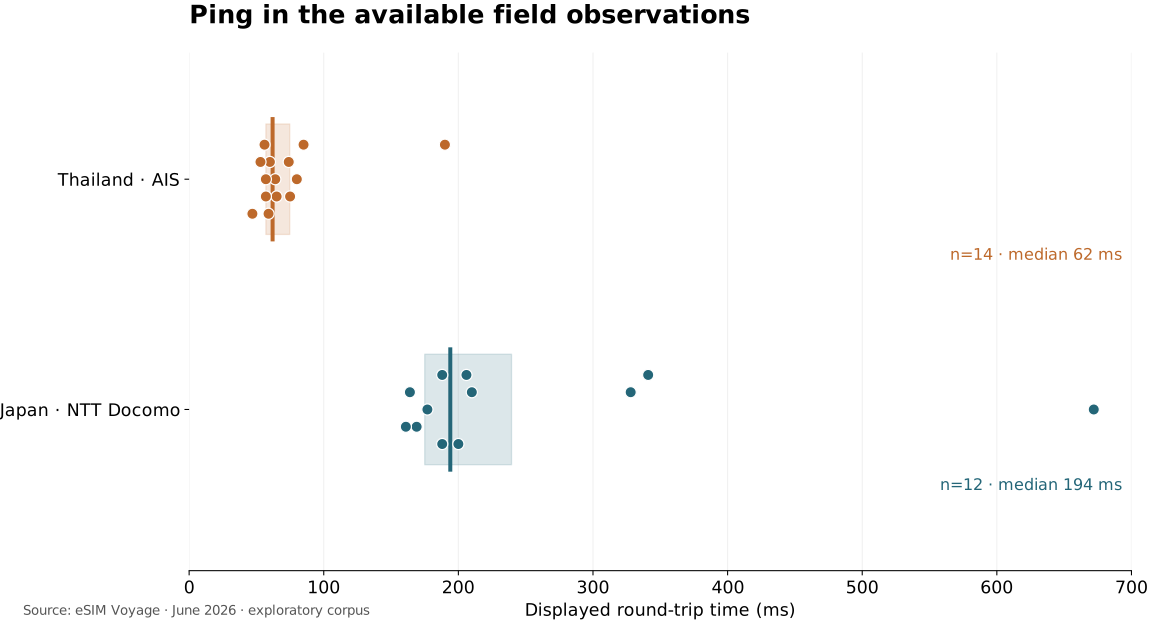

Thailand: strong AIS throughput, often to a Singapore server
The 19 Thai observations are concentrated on 16–17 June 2026: 16 on AIS and three on TrueMove H as declared locally. AIS ping has a 57–74.75 ms interquartile range and a 47–190 ms total range. Three TrueMove H records, only two with ping, cannot support an operator comparison.
| Cohort | n | Download | Upload | Ping | Jitter |
|---|---|---|---|---|---|
| AIS · 5G | 13 | 151 (n=13) | 33.8 (n=13) | 64 (n=13) | 10 (n=13) |
| AIS · Singtel | 12 | 159 (n=12) | 36.15 (n=12) | 62 (n=12) | 9.5 (n=12) |
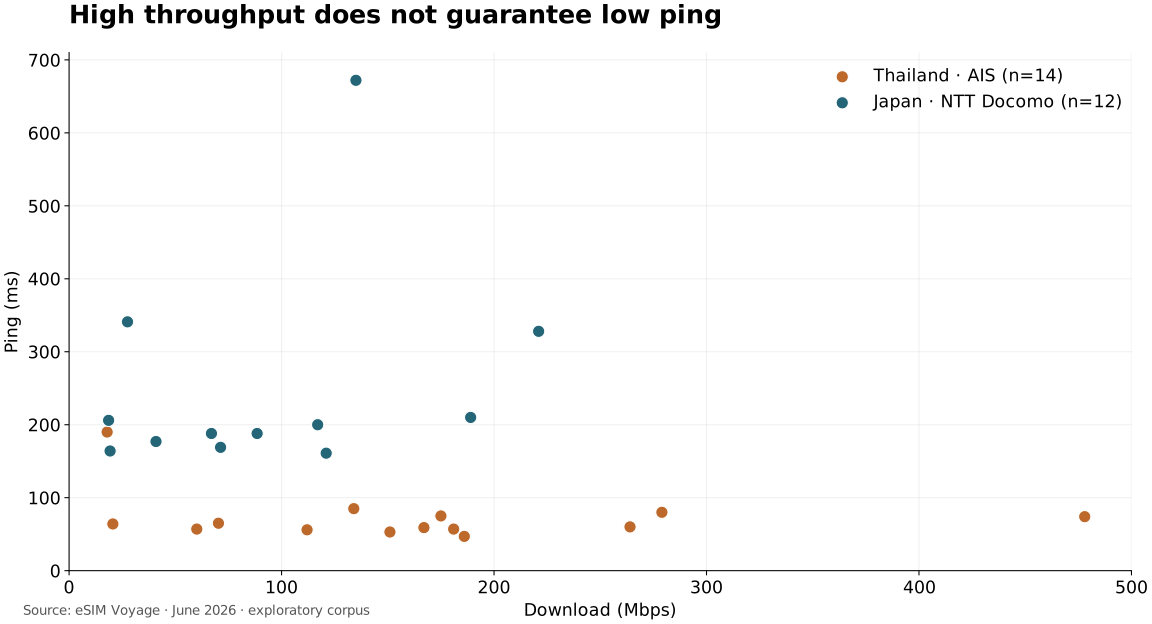
The 12 AIS/Singtel tests are labelled 5G on Samsung SM-G991B and target Singtel in Singapore. Their medians are 159 Mbps download, 36.15 Mbps upload, 62 ms ping and 9.5 ms jitter. They illustrate why download speed and responsiveness must be considered separately. Distance to the foreign target is a possible explanation, not proof of the actual Internet exit.
Verified example: Bangkok Chinatown, 17 June 2026 · 478 / 80,7 Mbps · 74 ms · jitter 3 ms. The original screenshot confirms these four values. This is an example, not the cohort median.
Two tests detect Hutchison HK but target TrueMove H in Surat Thani, with 190 and 164 ms pings. One declares AIS and the other TrueMove H. The contrast warrants future controls, not a causal conclusion from two different configurations.
Japan: high delay even with several Japanese test servers
Across 17–30 June 2026, all 12 Japanese records declare NTT Docomo and detect Hutchison HK. Median ping is 194 ms; the middle half spans 175–239.5 ms. Median download and upload remain 79.9 and 13.8 Mbps. Eight records identify a Pixel 9a and four omit the device. Five document 5G, one LTE and six omit the connection type.
| Cohort | n | Download | Upload | Ping | Jitter |
|---|---|---|---|---|---|
| Explicit 5G | 5 | 88.5 (n=5) | 12.6 (n=5) | 206 (n=5) | 34 (n=5) |
| Server listed in Japan | 7 | 71.3 (n=7) | 11.4 (n=7) | 188 (n=7) | 30 (n=7) |
Seven records place the server in Japan: Tokyo, Bunkyo, Chiba or Sanda. One places it in Hong Kong and four omit the location. The seven tests toward servers listed in Japan retain a 188 ms median ping. This rules out the simple description that all tests targeted Hong Kong, but does not establish the traffic route.
Nagoya Toyoake reaches 672 ms ping, confirmed on the original screenshot, with 135 Mbps download, 3.84 Mbps upload and 58 ms jitter. We retain it. Without this point, median ping is still 188 ms; leaving out each record in turn yields medians of 188–200 ms. Within this corpus, the signal does not depend on that one extreme.
South Korea: four M-Lab cases, not an equivalent third finding
Seven records dated 8–21 June 2026 declare LG U+. Six include latency and none includes jitter. Four explicitly use Google/M-Lab and target Hong Kong; three omit the source. The four documented cases have medians of 66.85 Mbps download, 31 Mbps upload and 147.5 ms displayed latency.
M-Lab NDT is not the same protocol as the Speedtest app. NDT7 documents MinRTT, a minimum during measurement; the Google screenshot does not establish equivalence to Ookla idle ping here. We therefore call this displayed M-Lab latency, keep the subgroup separate, and calculate no combined Asian ping.
NDT7 measurement metrics [mlab]Example: Incheon airport, 148 ms displayed toward Hong Kong
MedUX publishes an 82 ms LG U+ reference for 1 August–26 October 2025. Its page presents both on-net and off-net descriptions of latency measurement. Until that ambiguity is resolved, we retain it as documentary context, not a comparable local control or a causal-gap chart.
South Korea · October 2025 report [medux]Independent references: comparison without a causal penalty claim
| Network / scope | External period | Download Mbps | Upload Mbps | Latency ms | Source |
|---|---|---|---|---|---|
| AIS · All mobile | 2025-01-01 / 2025-12-31 | 77.02 | 19.9 | 27.75 | Thailand mobile Internet barometer 2025 [nperf-th] |
| AIS · 5G | 2025-01-01 / 2025-12-31 | 148.66 | 28.32 | 25.21 | Thailand mobile Internet barometer 2025 [nperf-th] |
| TrueMove H · All mobile | 2025-01-01 / 2025-12-31 | 77.16 | 24.24 | 29.55 | Thailand mobile Internet barometer 2025 [nperf-th] |
| TrueMove H · 5G | 2025-01-01 / 2025-12-31 | 142.18 | 47.98 | 24.94 | Thailand mobile Internet barometer 2025 [nperf-th] |
| NTT Docomo · All mobile | 2024-07-01 / 2025-06-30 | 53.22 | 9.68 | 61.64 | Japan mobile Internet barometer · July 2024–June 2025 [nperf-jp] |
| NTT Docomo · 5G | 2024-07-01 / 2025-06-30 | 132.2 | 16.15 | 46.8 | Japan mobile Internet barometer · July 2024–June 2025 [nperf-jp] |
The field AIS 5G subgroup (13 tests: medians of 151 Mbps, 33.8 Mbps and 64 ms) combines high throughput with latency above the nPerf 5G reference. Japan 5G (five tests: 88.5 Mbps, 12.6 Mbps and 206 ms) also shows higher delay, but lower throughput than its nPerf 5G reference. We do not claim local-network speed equivalence in every case.
- Our medians are not their means. All-mobile and 5G groups are not interchangeable.
- Locations, devices, times, protocols and servers are not paired; the external periods precede our tests.
- The barometers describe a national network, not a dedicated local-SIM campaign at our test locations.
- No “+X% latency caused by eSIM”, no subtraction interpreted as the roaming cost, and no significance test between incompatible aggregates.

Why 5G, the local network and ping describe different things
| Field | What it describes | What it does not establish |
|---|---|---|
| Declared local radio network | The mobile access listed in the record: AIS, NTT Docomo or LG U+ | Verified MCC-MNC, a local IP exit, or the same route as a domestic subscription |
| Detected network | The label shown by the application: Singtel or Hutchison HK | The tower operator, a measured ASN, or the gateway’s physical location |
| Test server | The exchange target and its listed location | The path taken or the server that Teams, Zoom or remote desktop will use |
eSIM is a SIM format: a local subscription can also be an eSIM. The digital form does not impose the delay. In roaming, traffic may use a distant exit; local breakout exits through the visited network. Distance, interconnections, load and server selection can increase round-trip time. Research supports the mechanism’s plausibility, not the topology of each profile in our corpus.
Trustworthy Local Breakout · March 2026 [lbo] · Unraveling the Airalo Ecosystem · 2024 [airalo]We observe detected-network labels alongside ping levels. These are descriptive associations confounded by destination, device, server and timing. Without public IP, ASN, a fixed endpoint and a paired local control, we cannot attribute the difference to a foreign exit or quantify its contribution. This edition performs and requires no traceroute.
Video meetings, VoIP and streaming: one connection, different constraints
Throughput measures transfer capacity, latency measures delay to a target, and jitter measures delay variation rather than its average. Packet loss and sustained stability also matter but are not established by this corpus. The effects below are documented mechanisms and practical risks, not results from recorded calls.
| Use | Possible delay effect | Essential nuance |
|---|---|---|
| Video calls / meetings | Less immediate responses, less natural turn-taking, overlap and unintended pauses | The call may remain usable with good video. Upload, jitter, loss, codecs and the service also matter. |
| VoIP | Delay between question and answer; a jitter buffer may add delay to stabilise audio | Low jitter does not mean delay-free conversation. We did not measure mouth-to-ear delay. |
| Cloud gaming | Commands travel to the server and the image returns: responsiveness may be substantially impaired | Test the actual game server. GeForce NOW requires below 80 ms to its infrastructure; Speedtest does not qualify the service. |
| Remote desktop / remote control | Cursor movement, scrolling, drawing, terminal interaction and rapid changes may feel delayed | Simple typing can remain comfortable. Measure RTT toward the remote desktop, not just a nearby server. |
| Conventional video streaming (VOD) | Startup and seeking may wait, but the player can prefetch segments | Sufficient sustained throughput and limited jitter: playback is generally comfortable thanks to buffering. Not a guarantee or a measured streaming result here. |
| Maps, web, downloads | Some requests start more slowly; throughput then helps with larger transfers | Often satisfactory without minimum ping. Offline maps help but do not certify the connection path. |
Quality of Service in Microsoft Teams [teams] · GeForce NOW system and network requirements [nvidia] · Azure Virtual Desktop connection quality [avd] · Media buffering, seeking and time ranges [buffer]
The 150 ms guidance in ITU-T G.114 concerns one-way transmission and speech delay, not Speedtest round-trip ping. Directly comparing our 194 ms ping with that threshold, or automatically halving it to estimate perceived delay, would be wrong. Encoding, buffers, processing and asymmetric paths can add delay.
G.114 · One-way transmission time [itu]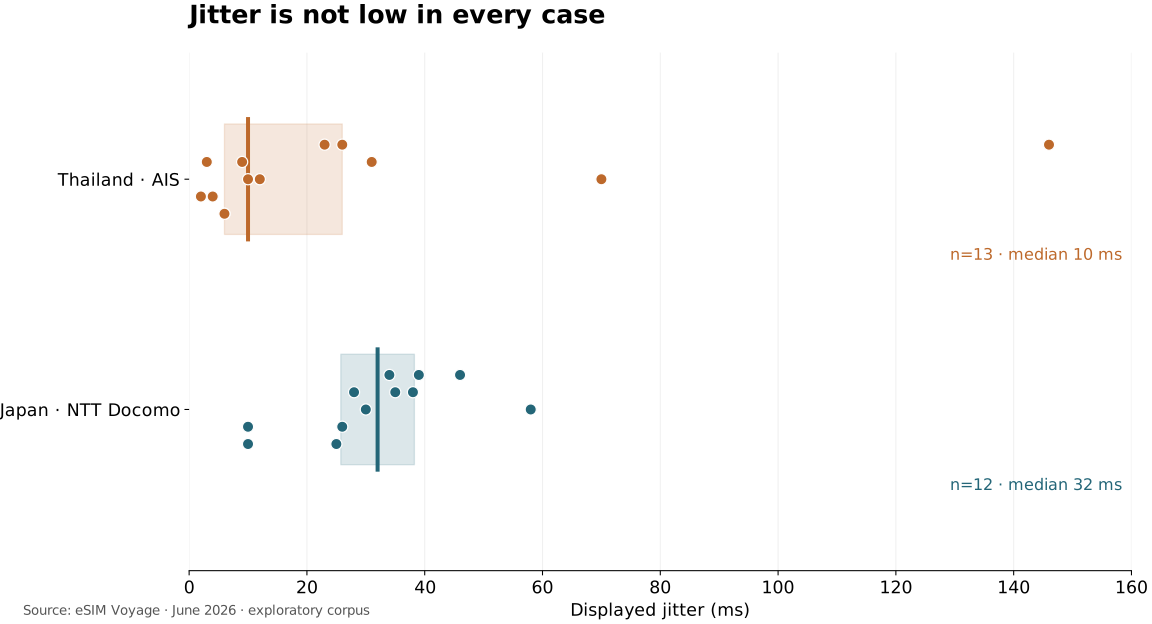

VOD buffering can receive video before playback. A conversation cannot be prefetched before the other person speaks. Low jitter makes arrivals steadier but does not cancel travel time. Ultra-low-latency live streams, interactive live chat and cloud gaming must not be treated as conventional video playback.
Digital nomad warning: test your work connection, not only Mbps
Do not choose your only work connection from a 5G label or a large download number. For interviews, client meetings, voice support or hours of remote desktop, validate delay and stability toward your actual services before depending on it. This is not a warning against every travel eSIM; it is a precaution for interactive work.
- On arrival: repeat two or three tests at different times, retain the server and result, then make a real test call. Check ping, jitter and upload; one speedtest does not predict all-day stability.
- Test the work path: hotspot if used, meeting software, remote desktop and a required corporate VPN. A VPN can change delay in either direction; it is not a universal fix.
- For highly interactive uses: compare a native local SIM/eSIM or a plan with documented local breakout. Request the exact reference and verify the result; “local” in an advertisement is not proof of a local exit.
- Have another tested access for important meetings: accommodation or coworking Wi-Fi, or another relevant line. Two brands can share the same roaming chain; do not assume independent backup.
- Maps, web and streaming often remain comfortable with sustained throughput and limited jitter. Do not change plans solely to save milliseconds without a concrete interactive need.
A local exit does not erase the distance between Asia and a workplace in Europe or the Americas. The best choice also depends on colleagues and server locations. This study does not measure performance toward any particular employer.
Reproducible methodology and selection criteria
- Field source: values already published in eSIM Voyage records and library table, extracted 14 September 2026. No private production dataset is exported. Three original screenshots are spot-checked for Bangkok, Nagoya and Incheon; this is not an exhaustive screenshot audit.
- Inclusion: Thailand, Japan or South Korea, a public record dated 8–30 June 2026, and a numeric value for the metric analysed. A record can contribute download but not ping if ping is missing.
- Exclusion: other destinations; missing values from that metric’s calculation; exact duplicates of a known Speedtest ID; no interpolation. The 17 published IDs have no exact duplicate. Missing IDs do not establish session independence.
- Calculation: numeric sorting, central-value median, and linearly interpolated quartiles h=(n−1)×q. JSON contains n, median, Q1, Q3 and range. No index, synthetic score, weighting or brand ranking.
- Checks: counts by country, network and source; 5G subgroups; documented Japanese servers; leave-one-out Japanese median. The verified 672 ms ping is retained; no opportunistic removal of extremes.
- Protocols: 26 speedtest_app records, four google_mlab, and eight without a documented source. Of those eight, four have latency and four do not. Unknown sources remain in the availability inventory, not a strict protocol comparison.
- Loaded latency: unused and omitted from the study export. Nagoya has a transcription discrepancy for those fields. Its idle ping, download, upload and jitter match the screenshot; full loaded-field reconciliation remains separate.
Loaded values are not removed to improve a result: this V1 simply does not claim to validate them. Publication does not modify the original measurement records.
Measured, associated, unproven: the limits to cite
| Level | What we can say |
|---|---|
| Measured / published | Displayed throughput, ping and jitter in spot records; medians recomputed with the stated sample counts. |
| Declared / detected | Listed local network and application label; not converted into a verified MCC-MNC or ASN. |
| Associated / plausible | High throughput and elevated delay coexist; roaming architecture and target choice may contribute. No causal coefficient. |
| Unproven | Exact route, physical exit country, eSIM-attributable penalty, national prevalence, actual call quality, loss, prolonged stability or brand superiority. |
The corpus is small, opportunistic and concentrated on a few days and devices. It does not represent every provider, eSIM plan, traveller or national network. It establishes neither the exact delivered plan nor a paired local-SIM campaign. Apps were not tested systematically. Unreported packet loss does not mean zero loss.
Drift Asia sells eSIMs and has a commercial interest in the subject. This study is not independent certification of its plans. External references come from separate organisations, but that does not make the field corpus independent of its publisher. No brand receives a score or performance promise.
The FR, MX and DriftAsia editions reuse the same Asian corpus. Translation and audience-specific advice do not create three independent field studies.
V2: a few high-value additional fields, without traceroute
- Public IP at each session, ASN and geolocated IP country, with provider and uncertainty. Keep identifying technical data private; the public annex should favour aggregated ASN and country.
- A fixed local endpoint per country, unchanged between profiles and repetitions; retain name, location, protocol, time, device and radio state. Add the relevant work endpoint separately.
- A local SIM/eSIM control on the same radio operator, phone, location and short time window, alternating profile order. Three repeats per session help but remain session-grouped, not three travellers.
- Plan reference without subscriber identifiers, app version, packet loss and correctly verified loaded ping; a short real call and remote-desktop operation if publishing application conclusions.
These additions would enable controlled, session-paired comparisons. IP geolocation would still not prove the whole physical route. No purchases, customer tests, IP collection or new measurements were performed for this V1.
Press: a clear angle with bounded conclusions
“A travel eSIM can download quickly while responding more slowly: Asian field tests make the case for checking ping before remote work.”
Permitted numerical citation: “Across 12 June 2026 Japanese records declaring NTT Docomo, eSIM Voyage recomputes a 194 ms median ping and 79.9 Mbps median download. This small exploratory corpus does not establish a causal roaming penalty.”
Do not claim: “all eSIMs have bad ping”, “video calls do not work”, “a Hong Kong exit is proven”, “a local SIM is always faster”, or “streaming was certified interruption-free”.
To cite or reuse our original charts: name Drift Asia, the title, 14 September 2026 date, sample counts and exploratory nature; link to this study and the JSON when using figures. Third-party documents and screenshots retain their own rights.
All studies · Press and corrections · Reproducible data and statistics
Sources and annex: every figure must remain traceable
- eSIM Voyage · Published field measurements · eSIM Voyage
- Thailand mobile Internet barometer 2025 · nPerf
- Japan mobile Internet barometer · July 2024–June 2025 · nPerf
- South Korea · October 2025 report · MedUX
- NDT7 measurement metrics · Measurement Lab
- Quality of Service in Microsoft Teams · Microsoft
- G.114 · One-way transmission time · ITU-T
- GeForce NOW system and network requirements · NVIDIA
- Azure Virtual Desktop connection quality · Microsoft
- Media buffering, seeking and time ranges · MDN
- Trustworthy Local Breakout · March 2026 · Aalto University / research publication
- Unraveling the Airalo Ecosystem · 2024 · Research paper
Sources checked 14 September 2026. Barometers are dated by collection period, not publication date alone. The original records below are in French, including in the international editions.
The 38 public records used
| Place / date | Declared / detected network | Server / listed location | Download | Upload | Ping / jitter | Source |
|---|---|---|---|---|---|---|
| Shizuoka Makinohara 2026-06-30 | NTT Docomo Hutchison HK | Contabo Non détecté | 27.5 | 3.63 | 341 / 39 | speedtest_app |
| Osaka Airport KIX 2026-06-30 | NTT Docomo Hutchison HK | IPA CyberLab 400G Non détecté | 19.3 | 12.6 | 164 / 38 | speedtest_app |
| Nagoya Toyoake 2026-06-30 | NTT Docomo Hutchison HK | Rakuten Mobile, Inc Sanda | 135 | 3.84 | 672 / 58 | speedtest_app |
| Tokyo Asakusa 2026-06-25 | NTT Docomo Hutchison HK | Contabo Tokyo | 71.3 | 11.4 | 169 / 10 | speedtest_app |
| Tokyo Narita 2026-06-22 | NTT Docomo Hutchison HK | IPA CyberLab Non détecté | 117 | 17 | 200 / 10 | speedtest_app |
| Sapporo Chitose Airport 2026-06-22 | NTT Docomo Hutchison HK | Non détecté Tokyo | 18.6 | 3.76 | 206 / 34 | speedtest_app |
| Sapporo Center 2026-06-22 | NTT Docomo Hutchison HK | STC Hong Kong | 189 | 25.9 | 210 / 28 | speedtest_app |
| Seoul Incheon Chinatown 2026-06-21 | LG U+ Non détecté | Google/MLab Hong Kong | 70 | 55 | 147 / N/A | google_mlab |
| Seoul Incheon Airport ICN 2026-06-21 | LG U+ Non détecté | Google/MLab Hong Kong | 71.9 | 33.8 | 148 / N/A | google_mlab |
| Tokyo Yoyogi 2026-06-18 | NTT Docomo Hutchison HK | Kairun Services Chiba | 40.9 | 9.43 | 177 / 30 | speedtest_app |
| Tokyo Shinjuku 2026-06-18 | NTT Docomo Hutchison HK | IPA CyberLab 400G Tokyo | 121 | 29.3 | 161 / 26 | speedtest_app |
| Tokyo Shibuya Crossing 2026-06-18 | NTT Docomo Hutchison HK | IPA CyberLab Bunkyo | 88.5 | 15 | 188 / 25 | speedtest_app |
| Tokyo Harajuku 2026-06-18 | NTT Docomo Hutchison HK | IPA CyberLab Bunkyo | 67 | 22.4 | 188 / 46 | speedtest_app |
| Trang City Center 2026-06-17 | AIS Singtel | Singtel Singapore | 112 | 33.8 | 56 / 26 | speedtest_app |
| Tokyo Haneda Airport Hnd 2026-06-17 | NTT Docomo Hutchison HK | Contabo Non détecté | 221 | 27.2 | 328 / 35 | speedtest_app |
| Thung Song Thung Song Junction 2026-06-17 | AIS Singtel | Singtel Singapore | 264 | 23.5 | 60 / 9 | speedtest_app |
| Surat Thani Phunpin Train Station 2026-06-17 | AIS Singtel | Singtel Singapore | 20.6 | 21.7 | 64 / 10 | speedtest_app |
| Phuket Andaman Sea 2026-06-17 | AIS Singtel | Singtel Singapore | 70.3 | 11.4 | 65 / 4 | speedtest_app |
| Krabi Bus Station 2026-06-17 | AIS Singtel | Singtel Singapore | 167 | 31.7 | 59 / 6 | speedtest_app |
| Koh Yao Noi Tha Khao Pier 2026-06-17 | AIS Hutchison HK | TrueMove H Surat Thani | 17.9 | 28.9 | 190 / 146 | speedtest_app |
| Koh Yao Noi Rice Fields 2026-06-17 | TrueMove H Non détecté | Non détecté Non détecté | 109.57 | 43.8 | N/A / N/A | Non détecté |
| Koh Yao Noi Paradise Hotel 2026-06-17 | AIS Non détecté | Non détecté Non détecté | 30.7 | 5.81 | N/A / N/A | Non détecté |
| Koh Yao Noi Long Beach 2026-06-17 | AIS Non détecté | Non détecté Non détecté | 82.7 | 9 | N/A / N/A | Non détecté |
| Hua Hin City Center 2026-06-17 | AIS Singtel | Singtel Singapore | 151 | 30 | 53 / 31 | speedtest_app |
| DMZ Demilitarized Zone 2026-06-17 | LG U+ Non détecté | Google/MLab Hong Kong | 63.7 | 5.54 | 155 / N/A | google_mlab |
| Chumphon Walking Street 2026-06-17 | AIS Singtel | Singtel Singapore | 279 | 70 | 80 / 12 | speedtest_app |
| Bangkok Wat Mongkon 2026-06-17 | AIS Singtel | Singtel Singapore | 175 | 47.1 | 75 / 2 | speedtest_app |
| Bangkok Siam Bts Station 2026-06-17 | AIS Singtel | Singtel Singapore | 186 | 99.9 | 47 / 6 | speedtest_app |
| Bangkok One Bangkok Lumphini 2026-06-17 | AIS Singtel | Singtel Singapore | 134 | 38.5 | 85 / 23 | speedtest_app |
| Bangkok Chinatown 2026-06-17 | AIS Singtel | Singtel Singapore | 478 | 80.7 | 74 / 3 | speedtest_app |
| Bangkok Central World (inside) 2026-06-17 | AIS Singtel | Singtel Singapore | 60.1 | 87 | 57 / 70 | speedtest_app |
| Bangkok Benchakiti Park 2026-06-17 | AIS Non détecté | Non détecté Non détecté | 181 | 37.3 | 57 / N/A | Non détecté |
| Seoul Beob Wangnu Temple 2026-06-16 | LG U+ Non détecté | Google/MLab Hong Kong | 61.3 | 28.2 | 146 / N/A | google_mlab |
| Koh Yao Noi Cape Kudu 2026-06-16 | TrueMove H Non détecté | Non détecté Non détecté | 46.5 | 8.35 | 168 / N/A | Non détecté |
| Koh Yao Noi 6 Senses Hotel 2026-06-16 | TrueMove H Hutchison HK | TrueMove H Surat Thani | 71.1 | 21.9 | 164 / 11 | speedtest_app |
| Busan Seafront 2026-06-13 | LG U+ Non détecté | Non détecté Non détecté | 82.5 | 30 | 153 / N/A | Non détecté |
| Gangneung City Centre 2026-06-09 | LG U+ Non détecté | Non détecté Non détecté | 58.7 | 32.3 | N/A / N/A | Non détecté |
| Gangneung Oval 2026-06-08 | LG U+ Non détecté | Non détecté Non détecté | 69.4 | 46.8 | 149 / N/A | Non détecté |
For destination planning, without treating this study as a guarantee: Thailand · Japan · South Korea