Tel Aviv eSIM Guide 2026: Connectivity in the Start-Up Nation Capital
Tel Aviv's mobile network in 2026
Tel Aviv is one of the best-connected cities in the Middle East and Eastern Mediterranean. The combination of four competing operators, a young and tech-savvy population, and Israel's national 5G rollout has produced a network environment that delivers 100-400 Mbps in the city's main coverage zones. Tel Aviv regularly appears in international speed benchmark rankings as one of the faster urban networks in the region.
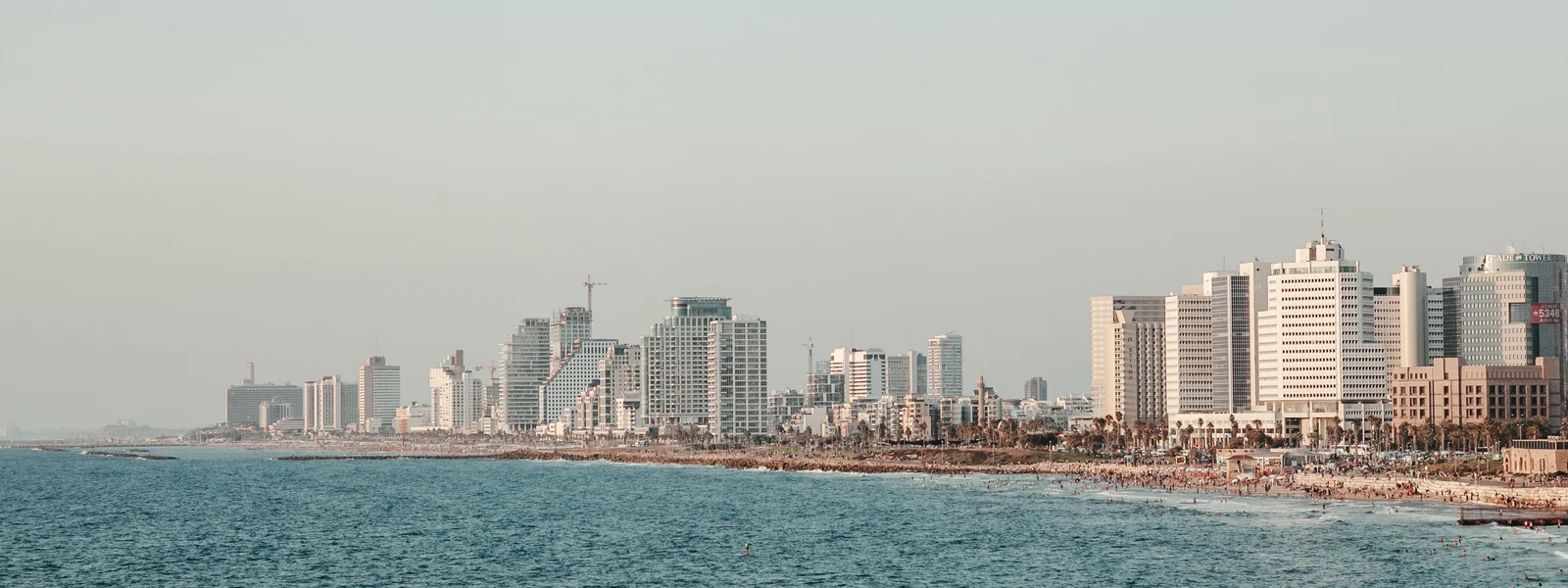
The 5G coverage map in Tel Aviv encompasses the central business district, the northern neighborhoods (Tel Aviv Port, Neve Tzedek, Florentin), the beachfront promenade (the Tayelet), and Rothschild Boulevard. The southern neighborhoods and Jaffa have strong 4G with partial 5G coverage expanding. For most practical purposes throughout the city, you will experience the fastest mobile data you have encountered in the Middle East.
Tel Aviv by neighborhood: connectivity guide
| Neighborhood | Coverage | Character |
|---|---|---|
| Rothschild Boulevard | Excellent 5G | Startup scene, cafes, iconic architecture |
| The Beach (Tayelet) | Excellent 5G + free municipal Wi-Fi | Mediterranean beaches from Jaffa to the north |
| Carmel Market area | Excellent 4G/5G | Vibrant market, food halls, Nachalat Binyamin craft market |
| Florentin | Strong 4G/5G partial | Trendy south Tel Aviv, street art, bars |
| Neve Tzedek | Excellent 5G | Upscale boutique neighborhood, galleries |
| Tel Aviv Port (Namal) | Excellent 5G | Renovated port with restaurants, weekend market |
| Jaffa Old City | Strong 4G | Ancient port city, flea market, galleries |
| HaKirya (Government area) | Excellent 5G | Business district, Azrieli Center towers |
Getting around Tel Aviv connected
Gett is Israel's dominant ride-hailing app -- far more drivers than Uber in Tel Aviv. Install before landing and link an international credit card. Gett works throughout the greater Tel Aviv metropolitan area and is the standard transport solution for any journey where walking, cycling, or public transit is impractical.
Tel Aviv has excellent public transport that is navigable with Moovit. The bus network is comprehensive, and the Tel Aviv Light Rail (Red Line, opened 2023) connects the city from north to south. Moovit provides real-time arrival information and step-by-step transit directions -- better than Google Maps for Tel Aviv public transport specifics.
Cycling: Tel Aviv has an extensive network of bike lanes and the Tel-O-Fun public bicycle sharing system. The app is in Hebrew but the bikes can be unlocked with an international credit card at the stations. The flat beachfront and city center terrain make cycling genuinely practical for getting between sights.
Tel Aviv beach connectivity
Tel Aviv's 14 km of urban beaches are one of the city's defining attractions. The entire beach promenade (the Tayelet) has both strong 5G mobile coverage and free municipal Wi-Fi. The Tel Aviv municipality has invested in beachfront Wi-Fi as a quality-of-life infrastructure -- a reflection of the city's tech culture applied to public space.
Each beach has its own character: Gordon Beach and Frishman Beach are the most tourist-oriented central beaches. Hilton Beach is known for LGBTQ+ community and dog beach sections. Metzitzim Beach to the north is calmer. All have consistent mobile and Wi-Fi coverage. The water itself obviously has no signal, but the beach chairs, cafes, and promenade all have strong coverage.
Coworking and digital nomad connectivity in Tel Aviv
Tel Aviv has a dense coworking infrastructure that reflects its status as the Middle East's leading startup hub. Major coworking brands (WeWork, Mindspace) operate multiple locations throughout the city. Independent coworking spaces in Florentin, Neve Tzedek, and along Rothschild Boulevard offer alternatives at various price points.
All coworking spaces connect to Israel's domestic fiber internet infrastructure -- 500 Mbps to 1 Gbps connections are standard. Your Israel eSIM serves as the mobile layer when moving between locations. Tel Aviv's 5G means the handoff from coworking Wi-Fi to mobile data is seamless -- no perceptible speed drop for standard work tasks.
Day passes at Tel Aviv coworking spaces run 50-150 ILS (14-42 USD). Monthly hot desks start at 800-1500 ILS (220-415 USD). For a short nomad stay, the day pass model with frequent cafe working as supplement is the most flexible approach.
Israel connectivity: the regional advantage
Israel's mobile network stands apart from its regional neighbors. Fast 5G in Tel Aviv, nationwide 4G, fully open internet, no VoIP restrictions, and some of the most competitive data pricing in the OECD. Whatever your specific connectivity need -- navigation, calls, streaming, remote work -- Israel's network delivers it without workarounds or compromises. Activate your eSIM before Ben Gurion and land in one of the region's best-connected countries.
- Install your Israel eSIM at home over Wi-Fi before departure
- Configure as data SIM alongside home SIM for dual-SIM operation
- Download Google Maps and Waze offline for all Israel destinations
- Install Gett (ride-hailing) and Moovit (transit) before landing
- No VPN needed -- WhatsApp calls, FaceTime, Zoom all work freely
- If crossing to Jordan or Egypt, install those eSIMs before departure too
Israel in the Middle East connectivity landscape
Understanding Israel's connectivity in its regional context helps set expectations before arrival. Israel occupies a unique position: it has the most Western-style open internet in the Middle East, some of the cheapest domestic mobile pricing in the OECD, and network quality that rivals major European capitals. At the same time, it is surrounded by countries with very different connectivity environments -- Jordan (open internet, moderate speeds), UAE and Qatar (excellent speeds, VoIP restrictions), Egypt (moderate speeds, some content filtering).
For travelers doing a broader Middle East circuit, Israel typically represents the high point of connectivity quality in the region. The open internet, fast speeds, no app restrictions, and competitive pricing combine into a connectivity experience that feels like Western Europe transplanted to the Eastern Mediterranean. No adjustments to your normal digital habits are needed -- use every app and service you would use at home, at speeds that often exceed what you experience at home.
| Factor | Israel | UAE | Jordan | Egypt |
|---|---|---|---|---|
| Network speed (urban) | Excellent (5G) | World-class (5G) | Good (4G) | Moderate (4G) |
| VoIP (WhatsApp calls) | Free, unrestricted | Blocked | Free, unrestricted | Free, unrestricted |
| Data pricing (local) | Very low (OECD) | High | Medium | Low |
| Internet freedom | High | Moderate (VoIP blocks) | High | Moderate |
| eSIM availability | Good | Good | Good | Limited |
Practical connectivity guide: what to prepare before Israel
A pre-departure preparation checklist for Israel connectivity takes 30-45 minutes and eliminates common frustrations during the trip. The checklist below applies regardless of which specific Israel itinerary you are following.
- eSIM installation: Install and test your Israel eSIM profile at home over Wi-Fi. Confirm it appears in your SIM settings before departure.
- Dual-SIM configuration: Set Israel eSIM as data SIM, home SIM for voice. Enable data roaming on Israel eSIM. Disable data roaming on home SIM.
- Offline maps: Download Google Maps offline for Tel Aviv, Jerusalem, the Dead Sea area, the Negev, and Eilat if visiting. Waze does not have an offline mode -- use Google Maps offline for drive navigation in no-signal areas.
- Apps to install: Gett (ride-hailing, dominant over Uber), Moovit (public transit navigation), Waze (driving navigation, Israeli favorite), your eSIM provider's app (data monitoring).
- WhatsApp contacts: Save accommodation, tour operator, and guide contacts in WhatsApp -- Israeli businesses communicate primarily on WhatsApp.
- No VPN needed: Israel has fully open internet. Uninstall BOTIM and any Gulf workaround apps if arriving from UAE or Qatar.
- Multi-country setup: If combining Israel with Jordan or Egypt, install all country eSIM profiles before departure and plan which profile to switch to at each border crossing.
Complete this preparation over a stable home Wi-Fi connection before departure. Discovering that your eSIM will not install, or that your offline maps did not download fully, is significantly easier to resolve at home than at Ben Gurion Airport at 2 AM after a long flight.
Tel Aviv food and nightlife: connectivity for the city's best experiences
Tel Aviv has one of the most vibrant restaurant and nightlife scenes in the Middle East. The city's culinary identity -- driven by the convergence of Israeli, Middle Eastern, Mediterranean, and international influences -- creates a dining environment where reservation apps, review platforms, and delivery services all matter.
Most Tel Aviv restaurants accept reservations through their Instagram direct messages or WhatsApp -- Israeli restaurant culture is mobile-first. Following restaurants on Instagram before your trip often reveals specials, reservation openings, and last-minute availability that does not appear on reservation platforms. Your eSIM handles the constant Instagram and WhatsApp connectivity this social-first dining culture requires.
Wolt (the Finnish food delivery platform) dominates food delivery in Tel Aviv ahead of local competitors. For evenings in your accommodation, Wolt covers all Tel Aviv neighborhoods with 25-45 minute delivery times. The app is fully English-language and accepts international credit cards. Wolt requires a live data connection for ordering and tracking -- your eSIM is the infrastructure that makes the Tel Aviv food delivery experience accessible.
Tel Aviv's nightlife extends until 4-6 AM on weekends, making late-night navigation and Gett bookings a practical connectivity need. Signal is strong throughout the night in Tel Aviv's main nightlife districts (Florentin, Rothschild, the port area). The 5G network in the city operates 24/7 -- no degraded performance during off-peak hours compared to the daytime experience.
Making the most of Israel's connectivity
Israel's mobile network is a genuine asset for the traveler. The speed, openness, and reliability of the network means that connectivity fades into the background -- you are not managing around restrictions, worrying about signal, or rationing data. The network just works, fast, everywhere you go in the country's main destinations.
Use this connectivity actively: WhatsApp your accommodation for early check-in before you arrive in Tel Aviv. Stream Spotify on the bus from Ben Gurion to Jerusalem. Video call home from the Western Wall Plaza at golden hour. Post your Dead Sea floating photo in real time. Navigate the Jaffa flea market with live Google Maps. These experiences that require reliable connectivity are available in Israel in a way that is not guaranteed in the broader region.
The practical bottom line: buy a well-priced eSIM from a reputable provider with confirmed Israeli operator routing, install it before departure, configure your dual-SIM setup, download your offline maps, and land in Israel ready to focus on the extraordinary destination rather than the connectivity management. Israel is one of the easier Middle East countries to be connected in -- let it be easy.
Summary: Israel eSIM planning guide
To recap the key decisions for Israel connectivity: choose a plan that routes through Cellcom for desert itineraries or Partner for Tel Aviv 5G performance; size your plan at 10-15 GB for a 7-10 day mixed itinerary; activate before departure at home over Wi-Fi; configure dual-SIM with your home line active for voice; download Google Maps offline for all destinations; install Gett and Moovit before landing. WhatsApp calls, FaceTime, Zoom, and all communication apps work freely with no VPN or workaround needed. Israel is one of the most straightforward connectivity environments in the Middle East -- plan adequately and the network will not be a constraint on your experience.
For longer stays or more data-intensive use: consider a local Israeli SIM from Partner, Cellcom, or Hot Mobile. The per-GB pricing is significantly lower than international eSIM plans. A 20 GB local plan from a carrier store costs 11-19 USD -- a fraction of equivalent international eSIM plan pricing. The registration process at any carrier store takes 10-15 minutes and requires only your passport. For 10+ day stays where data quantity matters, the local SIM is the economically rational choice despite the convenience premium of eSIM for shorter visits.
Get your Israel eSIM
Navigate Tel Aviv's 5G city from beach to boulevard with working data.
FAQ
Is 5G available throughout Tel Aviv?
5G covers most of central Tel Aviv including the beach promenade, Rothschild Boulevard, the northern neighborhoods, and the Tel Aviv Port area. Coverage expands in 2026. Partner and Pelephone deliver the strongest 5G performance in the city.
What is the best ride-hailing app in Tel Aviv?
Gett is the dominant ride-hailing app in Israel, with significantly more driver availability than Uber in Tel Aviv. Install Gett and link a payment method before landing. Both apps work on Israel's 4G/5G network without restriction.
Is there free Wi-Fi in Tel Aviv?
Yes. Tel Aviv has free municipal Wi-Fi along the beachfront promenade (the Tayelet), in Rabin Square, and at various public spaces. Many cafes and restaurants offer free Wi-Fi. The municipal Wi-Fi is fast enough for messaging and browsing -- your eSIM handles the gaps.