4G Coverage in Azerbaijan 2026: Azercell, Bakcell and Nar Explained
The Three Networks That Power Azerbaijan
Azerbaijan's mobile landscape is anchored by three operators: Azercell, Bakcell, and Nar Mobile. A fourth brand, Naxtel, operates mainly in the Nakhchivan Autonomous Republic using CDMA infrastructure -- it is irrelevant for travel eSIMs.
Azercell was established in 1996 as a joint venture between the Azerbaijani government and Turkey's Turkcell. Today it commands roughly 48-51% of the subscriber market with over 5 million active connections. Its 4G LTE network covers an estimated 94-98% of both population and territory -- figures that make it the unambiguous coverage leader for anyone leaving Baku. Bakcell, owned by Swedish Millicom, holds the second-largest share and consistently earns the highest urban speed rankings in Baku. Nar Mobile (formally Azerfon) completes the trio with a growing footprint and competitive tourist tariffs.
For travelers, what matters is simple: most international travel eSIMs roam on Azercell or Bakcell partner agreements. You will get 4G LTE across every mainstream tourist destination without any manual configuration.
4G LTE Coverage by Region
Baku and the Absheron Peninsula
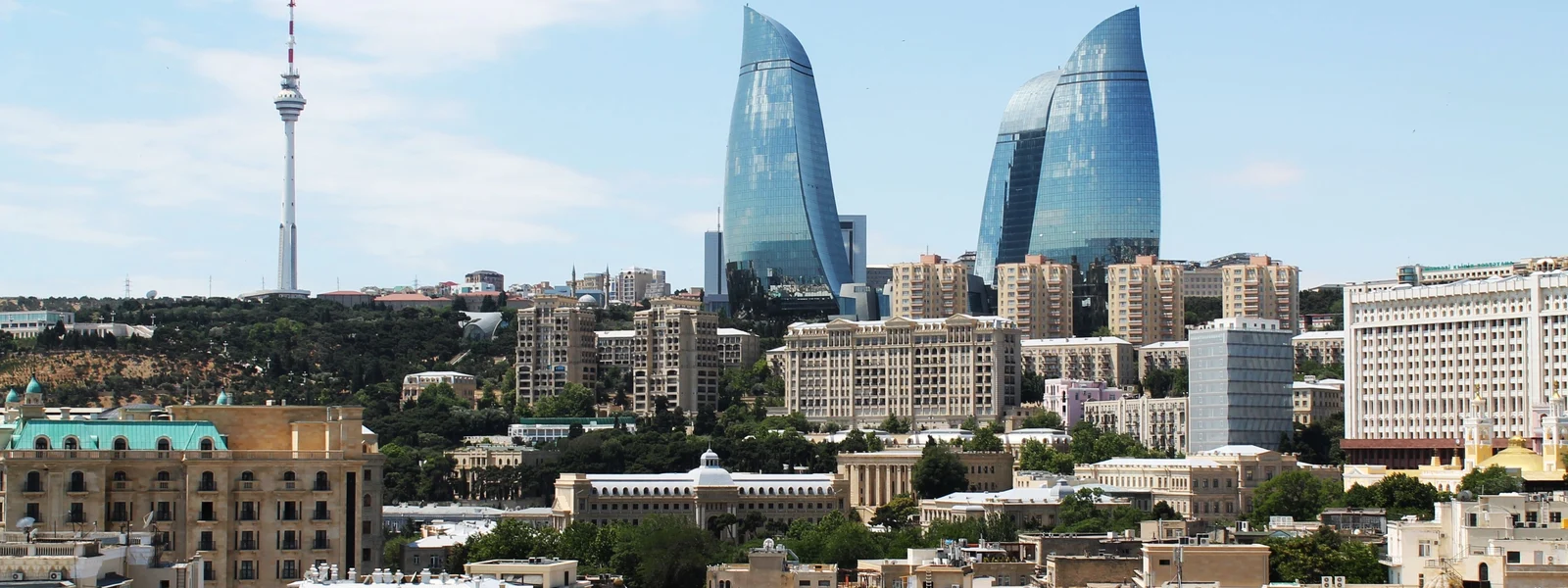
Baku delivers some of the best urban mobile performance in the South Caucasus. All three operators maintain dense 4G LTE infrastructure across the city center, the seafront Bvd promenade, the UNESCO-listed Old City (Icherisheher), and out to Heydar Aliyev International Airport. Bakcell in particular has aggressively densified its Baku network to support high-traffic zones around Flame Towers, Nizami Street, and the 2024 COP29 conference venues. Expect consistent 20-60 Mbps download speeds across central Baku on either major operator.
The Absheron Peninsula, stretching northeast from Baku toward Mardakan and Novkhani, has solid 4G coverage along main roads. The peninsula is a popular day-trip destination for its mud volcanoes, fire mountains (Yanar Dag), and beach areas. Signal is reliable at all key attractions.
Greater Baku Suburbs and Sumqayit
Sumqayit, Azerbaijan's third-largest city 30 km north of Baku, has full 4G coverage from all three operators. The industrial corridor between Baku and Sumqayit -- a frequent transit route -- maintains consistent signal throughout. Southern suburbs including Pirallahi island and the Sangachal oil terminal area have reasonable coverage, though network load from industrial operations can occasionally affect speeds.
Ganja and the Western Corridor
Ganja, Azerbaijan's second city (population ~335,000), has comprehensive 4G LTE coverage. The M1 highway connecting Baku to Ganja -- roughly 375 km -- is well covered throughout, making it suitable for navigation, music streaming, and WhatsApp calls during road trips. Smaller towns along the route, including Shamkir and Goygol, have 4G at town centers with some 3G gaps in agricultural stretches between settlements.
Sheki and the Northern Caucasus Foothills
Sheki -- one of Azerbaijan's most beloved tourist destinations, famous for its caravanserai, Silk Road history, and Khan's Palace -- has 4G coverage in the town center from both Azercell and Bakcell. The road from Yevlakh to Sheki (approximately 100 km, heading into the Caucasus foothills) maintains 4G on most of the route with occasional signal dips in the steeper canyon sections approaching town. Within Sheki itself, coverage is reliable at all major sights. Expect 4G to drop to 3G or edge once you venture more than 5-10 km into surrounding mountain villages.
Quba, Lahic, and the Greater Caucasus
Quba, a popular destination for its apple orchards, Azerbaijani Jewish communities (the nearby village of Qirmizi Qasaba is one of the world's last Jewish rural communities), and access to higher Caucasus trails, has 4G coverage at the town level. Azercell's rural reach extends further than competitors here. The village of Xinaliq, one of the highest continuously inhabited settlements in the Caucasus at around 2,350 meters, sits near the edge of reliable coverage -- expect intermittent 3G or no signal beyond Quba's immediate surroundings in mountain terrain.
Gobustan and Southern Routes
Gobustan National Park -- famous for its mud volcanoes and Bronze Age petroglyphs -- is located roughly 65 km south of Baku along the Caspian coast. The main visitor area has 4G signal from Azercell, adequate for navigation and photo uploads. The road south toward Lankaran follows the Caspian coast and maintains 4G throughout most of its length. Lankaran itself, near the Iranian border, has full urban 4G coverage.
Nakhchivan
Nakhchivan is an Azerbaijani exclave separated from the main country by Armenian territory. It has its own network infrastructure (primarily Azercell and Naxtel). Coverage exists in Nakhchivan city and major settlements. However, getting there requires flying from Baku or entering via Iran or Turkey -- the land route through Armenia has been closed since the early 1990s. Most travel eSIMs with regional Azercell agreements will roam normally in Nakhchivan.
Karabakh Region
Following the 2023 reintegration of Karabakh (formerly Nagorno-Karabakh), Azerbaijan has rapidly expanded telecommunications infrastructure in the region. Shusha -- declared a cultural capital by Azerbaijan -- and Khankendi (formerly Stepanakert) have growing 4G coverage from Azercell. Network construction is still ongoing as of 2026, and coverage in rural Karabakh can be spotty. If you are visiting as part of an organized tour (currently the main way to access the region), your guide will advise on connectivity expectations.
5G in Azerbaijan: Early Rollout
Both Azercell and Bakcell have conducted 5G trials and begun limited commercial deployment in Baku. As of 2026, 5G coverage is confined to select central Baku districts and is still in expansion mode. The Opensignal Global Network Excellence Index ranks Azerbaijan 65th overall with around 81% 4G/5G availability -- a respectable figure for a mid-sized emerging market. For the vast majority of travelers, 4G LTE remains the working standard and delivers entirely adequate speeds for all travel applications.
If your device supports 5G (most premium phones released after 2021), you may experience 5G speeds in Baku's central business district. However, do not count on 5G as a baseline -- plan around 4G LTE and treat 5G as a pleasant bonus.
Frequency Bands: Will Your Phone Work?
Azerbaijan's 4G LTE networks operate primarily on Band 3 (1800 MHz) and Band 7 (2600 MHz), with Band 20 (800 MHz) used for rural low-frequency coverage by Azercell. Most modern smartphones -- including all recent iPhone models, Samsung Galaxy S and A series, Google Pixels, and flagship Android devices from OnePlus, Xiaomi, and Huawei -- are fully compatible. If you are traveling with an older or budget device, check that it supports at least Band 3 (1800 MHz) for reliable 4G access.
CDMA devices (older Verizon or Sprint phones from the US market) will not work on Azerbaijan's GSM-based network. Dual-SIM and eSIM-capable devices will have no compatibility issues on the major operators.
Airport Connectivity
Heydar Aliyev International Airport (GYD) in Baku is served by all three operators. 4G LTE is available in the arrivals hall, transit zones, and departures. If your eSIM is already installed and activated before departure, it will typically connect automatically once your aircraft enters Azerbaijan's airspace or immediately on landing. You do not need to find Wi-Fi to activate a pre-installed eSIM -- the process is entirely automatic for supported devices and plans.
Dead Zones and Connectivity Gaps
Even with Azerbaijan's strong national coverage metrics, some areas warrant realistic expectations:
- High Caucasus trails above 2,000 m: Coverage drops to 3G or no signal in most areas above Quba and Sheki at significant altitude. Download offline maps before heading out.
- Remote Talysh mountain villages near the Iranian border south of Lankaran have variable 3G, with some gaps in deep valleys.
- Karabakh rural areas are still undergoing infrastructure buildout -- expect patchy coverage outside main towns.
- Kura River delta and Mingachevir Reservoir: Coverage exists in the city of Mingachevir but gets sparse in low-population wetland areas.
For any off-piste hiking or backcountry travel, download maps.me or Google Maps offline data for your route before leaving a city. This is standard practice for Caucasus trekking regardless of which country you are in.
Summary: Coverage Expectations for Common Itineraries
For the classic Baku city break (3-5 days), you will have full 4G LTE at all times. For the popular Baku-Sheki-Quba circuit (7-10 days), expect 4G in all town centers and on main highways, with occasional 3G in mountain approaches. For Gobustan and Absheron Peninsula day trips from Baku, coverage is solid throughout. The further you venture into the Greater Caucasus or remote Karabakh countryside, the more 4G gives way to 3G -- but even there, Azercell's network reaches far beyond what many visitors expect from a South Caucasus destination.
Network Performance Benchmarks
Independent network testing organizations provide useful benchmarks for Azerbaijan's mobile performance. Opensignal's Global Network Excellence Index placed Azerbaijan 65th overall with approximately 81% 4G/5G availability -- a competitive figure for a country of its size and geographic complexity. Ookla's Speedtest Global Index shows median mobile download speeds in the 20-40 Mbps range for Azerbaijan, with Baku significantly outperforming national averages at 35-70 Mbps in dense urban measurements. These figures reflect real-world performance across all network users and give travelers a calibrated baseline expectation.
For comparison, neighboring Georgia scores slightly higher on availability metrics but Azerbaijan is broadly comparable in urban performance quality. Armenia's network performs similarly in Yerevan. Among the South Caucasus trio, all three countries offer adequate 4G for standard travel use, with Azerbaijan's larger investment base showing in Baku's urban network density specifically.
Future Network Development
Azerbaijan's government has stated commitments to expanding 5G coverage beyond Baku's central districts and to extending 4G reach into remote areas that currently have 3G-only or no coverage. The Karabakh reconstruction program explicitly includes telecommunications infrastructure as a priority, and Nakhchivan's network has been earmarked for quality improvements. Travelers visiting Azerbaijan in the latter part of 2026 and beyond may find improved coverage in areas that currently have gaps, particularly in the Karabakh region and in rural sections of northern Azerbaijan near the Georgian border.
For current conditions, independent coverage verification tools (the nPerf app, which collects real user measurements, and the official operator coverage maps on Azercell.com and Bakcell.com) provide the most up-to-date information for specific areas you plan to visit. Cross-reference these with recent traveler reports on forums and travel communities for ground-truth accuracy, since official coverage maps are optimistic by design while user reports reflect actual experience.
Practical Network Configuration for Travelers
Most smartphones on automatic network selection will connect to the strongest available signal regardless of operator. In Azerbaijan, this usually means Azercell in rural and mountain areas (where it has the widest footprint) and either Azercell or Bakcell in urban areas (where both have dense infrastructure). If you experience persistent 3G rather than 4G in an area that should have 4G, the following manual intervention often resolves it: go to Settings and find Mobile Network or Cellular options, select Network Mode or Preferred Network Type, and choose "LTE/4G" rather than "Automatic" or "3G/4G/LTE." This forces the phone to prefer 4G when available rather than falling back to 3G for signal stability. In Baku and major towns, this setting consistently delivers faster speeds than leaving the phone on automatic selection.
FAQ
Which network has the best coverage in Azerbaijan?
Coverage quality varies by region. Check the guide above for operator-by-operator breakdown across Azerbaijan's main tourist areas.
Is 5G available throughout Azerbaijan?
5G availability depends on the specific area. Urban centers have the best 5G coverage while rural areas typically rely on 4G LTE.
What should I download offline before visiting Azerbaijan?
Download Google Maps offline for Azerbaijan before departure. This eliminates data dependency for navigation and works even in areas with poor signal.