We tested six travel eSIMs in Thailand
108 valid tests across 16 locations. A six-location comparison shows how download speed, latency and local networks can tell different stories.
Southern Thailand and Bangkok · 24 September to 1 October 2026

36 measurements across six common locations form the main direct-comparison benchmark.
The short version
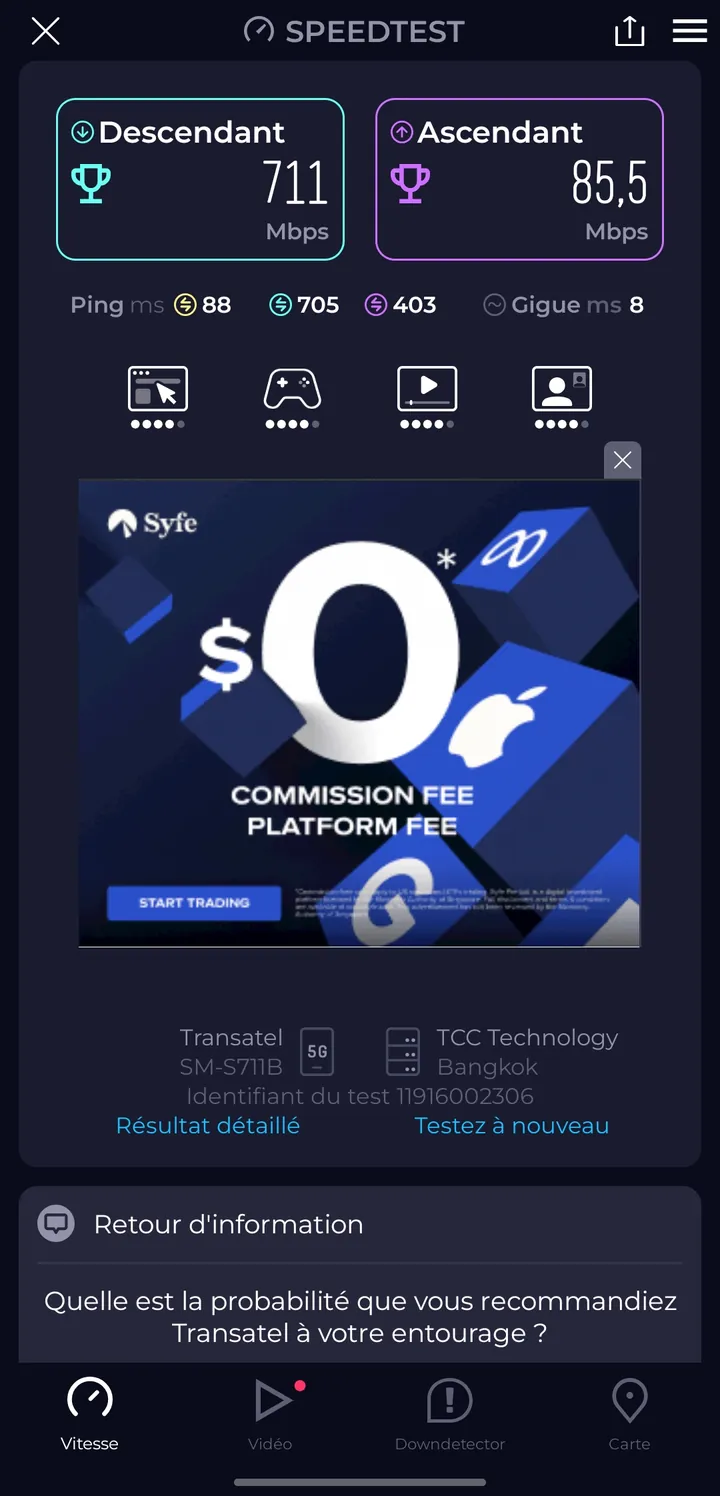
- Ubigi reached 711 Mbps at Ao Nang. That individual peak sits alongside a much lower result at another location.
- Saily had the lowest median ping, 81 ms. It also had the highest upload median in the six-location comparison.
- Location mattered. No provider led every metric at every place. A fast download and a responsive connection are different things.
Six locations, six eSIMs, the same phone
The main comparison uses 36 measurements: one result for each provider at Surat Thani, Phunphin, Bangkok Lumpini, Bangkok Silom, Krabi and Ao Nang. Comparing the same places gives a more useful picture than picking each provider’s best result from anywhere in the campaign.
| Test profile / provider | Download median (Mbps) | Upload median (Mbps) | Ping median (ms) | Jitter median (ms) |
|---|---|---|---|---|
| Airalo | 114 | 50.2 | 478 | 8 |
| Nomad | 114 | 20.5 | 155 | 12 |
| Saily | 301 | 74.6 | 81 | 4.5 |
| Thailand Performance test profile | 330 | 73.8 | 125.5 | 9 |
| Ubigi | 110 | 60.9 | 88 | 8.5 |
| Yesim | 134 | 27.5 | 398 | 10 |
Scroll sideways on smaller screens.
About the tested profile. The Thailand Performance test profile was bought through our French sister site eSIMVoyage. We have not confirmed that it is the same underlying plan currently sold by DriftAsia. Its historical measurements are kept separate from our present-day offers.
In the figures, Performance profile* is a shorter label for that historical Thailand Performance test profile.
Download and upload tell different stories
Median download
Median upload
The Performance profile’s median download was 330 Mbps, followed by Saily at 301 Mbps. Upload was much closer: Saily’s 74.6 Mbps was slightly above the Performance profile’s 73.8 Mbps. Upload capacity matters when sending photos, backing up files or sharing a connection for work.
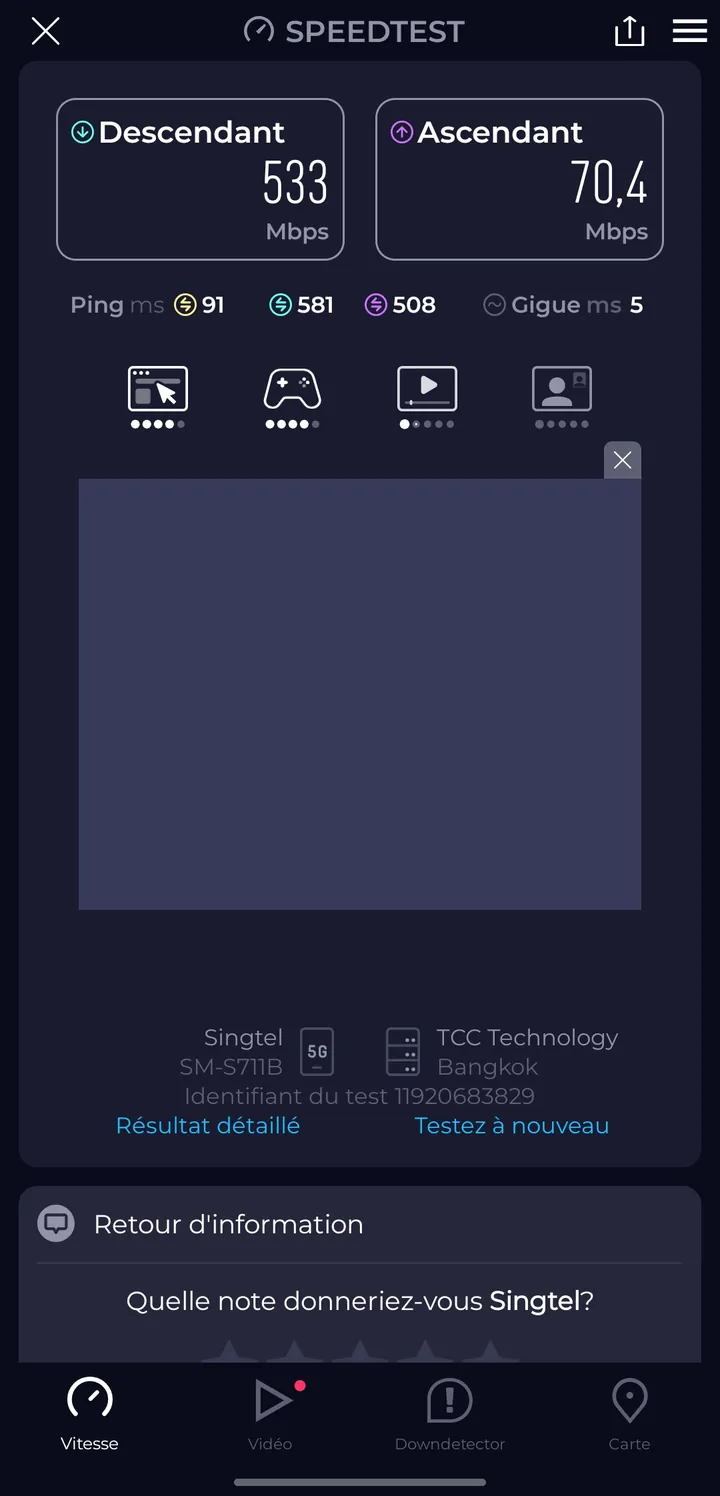
All six Performance download measurements were above 200 Mbps, ranging from 226 to 533 Mbps. It was the only profile in this panel to do so across all six common locations. That is a consistency result in this particular comparison, not a promise of 200 Mbps everywhere.
The peak speed is only part of the story
One provider, very different speeds
Minimum / median / maximum download, Mbps
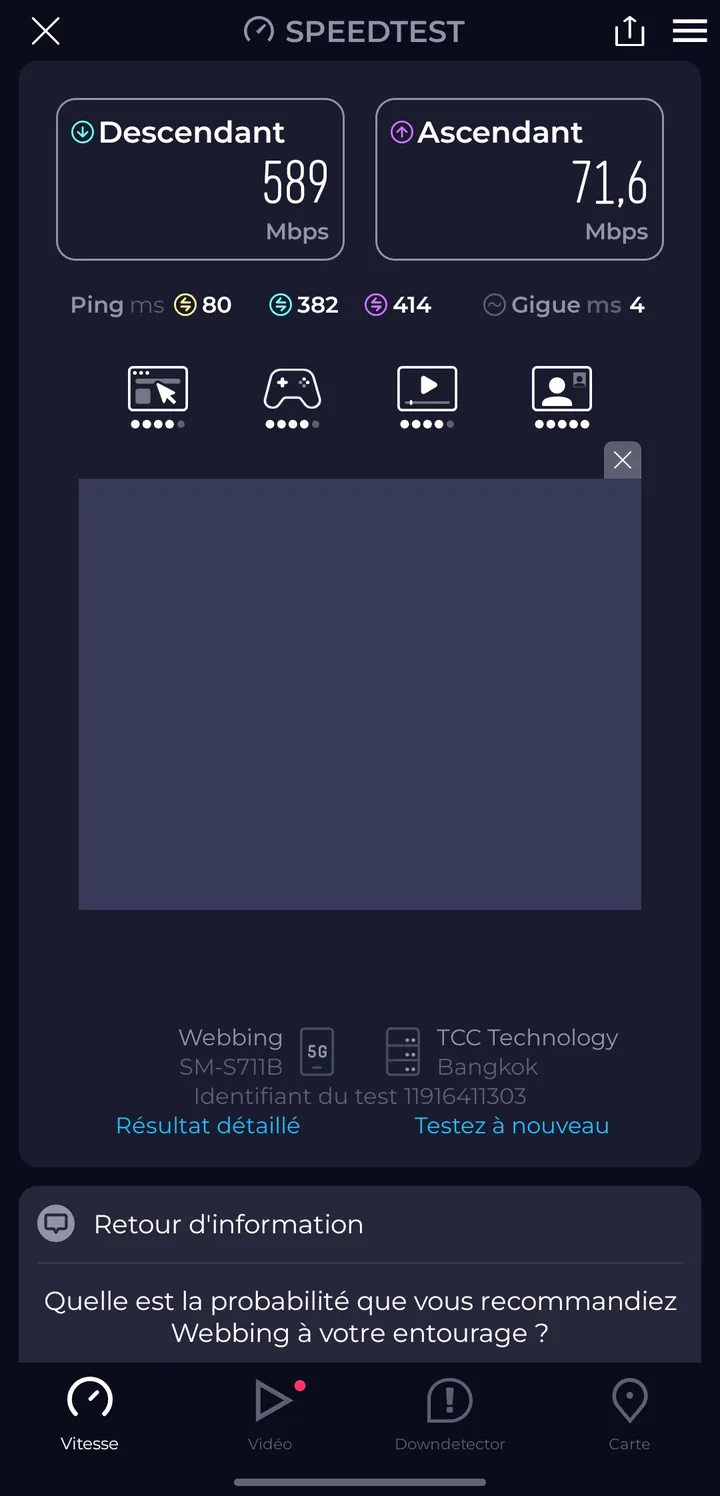
Saily went from 58.5 Mbps at Phunphin to 670 Mbps at Ao Nang, with 589 Mbps at Surat Thani. Ubigi ranged from 46.9 Mbps at Silom to 711 Mbps at Ao Nang. Both delivered outstanding individual downloads and much lower readings elsewhere. The Performance profile stayed between 226 and 533 Mbps; all six of its downloads remained above 200 Mbps.
The attached network, local cell, signal conditions, congestion, time of day and international infrastructure can all affect a connection. They are plausible explanations for variation, but this campaign did not isolate their individual effects. A provider’s median is a summary of these locations, not a prediction for your next hotel.
See all 36 download / upload results
| Location | Airalo | Nomad | Saily | Performance profile* | Ubigi | Yesim |
|---|---|---|---|---|---|---|
| Surat Thani | 95.0 / 38.6 | 150 / 21.3 | 589 / 71.6 | 408 / 84.2 | 106 / 36.6 | 55.0 / 28.7 |
| Phunphin | 45.9 / 21.1 | 39.9 / 34.3 | 58.5 / 33.8 | 226 / 74.5 | 54.0 / 23.1 | 50.7 / 35.8 |
| Bangkok Lumpini | 107 / 61.8 | 152 / 73.7 | 105 / 86.2 | 252 / 79.0 | 114 / 85.2 | 238 / 76.1 |
| Bangkok Silom | 121 / 5.28 | 146 / 15.6 | 202 / 10.6 | 248 / 12.8 | 46.9 / 7.69 | 199 / 10.0 |
| Krabi | 194 / 90.7 | 82.7 / 5.58 | 400 / 78.2 | 436 / 73.1 | 589 / 107 | 112 / 26.2 |
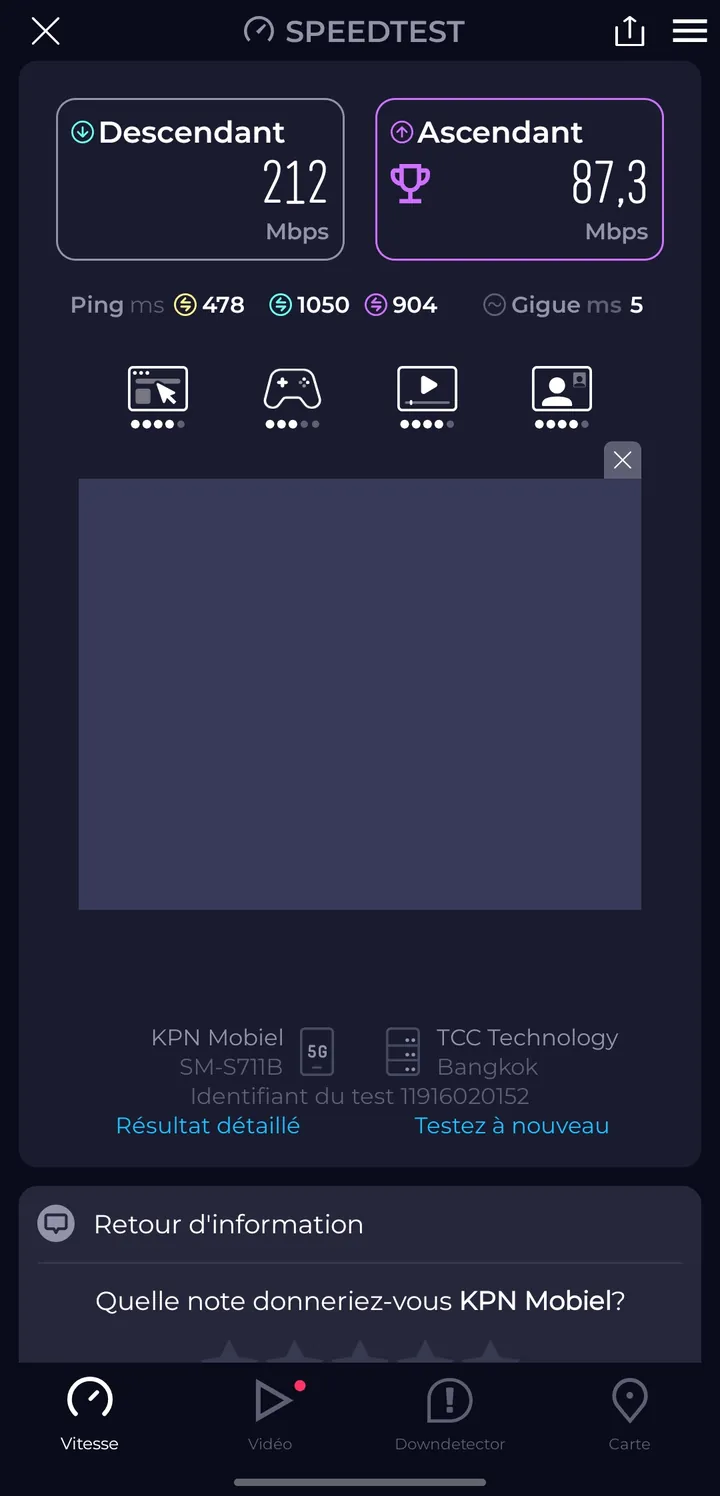
| Ao Nang | 212 / 87.3 | 44.6 / 19.6 | 670 / 77.6 | 533 / 70.4 | 711 / 85.5 | 156 / 20.9 |
Scroll sideways on smaller screens.
High Mbps does not always feel fast
Ping
Responsiveness: the time for a request to travel to the test server and back. It matters for calls, games and interactive work.
Jitter
Latency variation: how much that delay changes. Sudden changes can disturb voice or video, even when throughput is high.
Loaded latency
Responsiveness while data is being transferred. A call may behave differently when a cloud backup or hotspot download is running.
Median idle ping
Saily’s 81 ms and Ubigi’s 88 ms were below the Performance profile’s 125.5 ms. Yesim and Airalo had medians of 398 ms and 478 ms respectively. At Ao Nang, Airalo still downloaded at 212 Mbps while its idle ping was 478 ms: throughput alone would miss that difference.
Jitter and latency while downloading or uploading
| Test profile / provider | Idle ping (ms) | Jitter (ms) | Loaded download (ms) | Loaded upload (ms) |
|---|---|---|---|---|
| Airalo | 478 | 8 | 1061 | 1140 |
| Nomad | 155 | 12 | 740 | 1288 |
| Saily | 81 | 4.5 | 700 | 507 |
| Thailand Performance test profile | 125.5 | 9 | 612 | 547 |
| Ubigi | 88 | 8.5 | 606 | 600 |
| Yesim | 398 | 10 | 857 | 1415 |
Scroll sideways on smaller screens.
There is no universal line between a good and a bad connection. Server distance, the application and what else is using the link all matter.
Streaming
Download throughput
Cloud backup
Upload throughput
Video calls
Upload, ping and jitter
Gaming
Ping and jitter
Remote work
Ping, upload and loaded latency
Hotspot
Download, upload and loaded latency
A Thai mobile network does not guarantee a Thai Internet exit
Thailand
The radio network attached to the phone: AIS, dtac or TrueMove H.
Public IP and ASN
The country and network reported by IPinfo. This is a different layer of the connection.
| Profile / provider | Apparent IP country | Observed ASN | Campaign observation |
|---|---|---|---|
| Thailand Performance test profile (main route) | Singapore | AS45143 (Singtel) | Singapore in this route; AIS most often observed locally |
| Thailand Performance test profile (secondary route) | Singapore | AS58453 (CMI) | Separate configuration, outside the main benchmark |
| Saily | Singapore | AS214155 (Webbing) | Stable apparent breakout in the campaign |
| Nomad | Mainly Hong Kong | AS153611 (csl / 1O1O) | One Warsaw observation: AS8374 |
| Ubigi | Often UK / London; sometimes Singapore | AS138199 (Transatel) | Apparent breakout varies |
| Airalo | Netherlands | AS1136 (KPN) | Netherlands in the observed sessions |
| Yesim | Mainly UK | AS208893 | Two variations: AS1299 at Slough; AS153611 at Hong Kong |
Scroll sideways on smaller screens.
The apparent country of the public IP indicates the visible breakout location, not necessarily the complete physical path taken by the packets. An ASN identifies a network, not every hop on the journey. These observations can help explain why local radio speed and responsiveness do not always move together, but they do not prove a single cause.
The network we saw, and the networks a plan offers
NetMonster recorded the Thai network actually attached during each test. That is different from a list of operators included in a plan: the phone was not using all three networks at once.
| Test profile / provider | Network observations |
|---|---|
| Thailand Performance test profile | AIS 11; TrueMove H 8; dtac 8; 2 unreadable captures |
| Airalo | AIS 9; TrueMove H 8 |
| Saily | AIS 9; dtac 4; TrueMove H 1; 2 unreadable captures |
| Nomad | dtac 9; TrueMove H 6 |
| Ubigi | AIS 14/14 |
| Yesim | dtac 14/16; TrueMove H 1; 1 unreadable capture |
Scroll sideways on smaller screens.
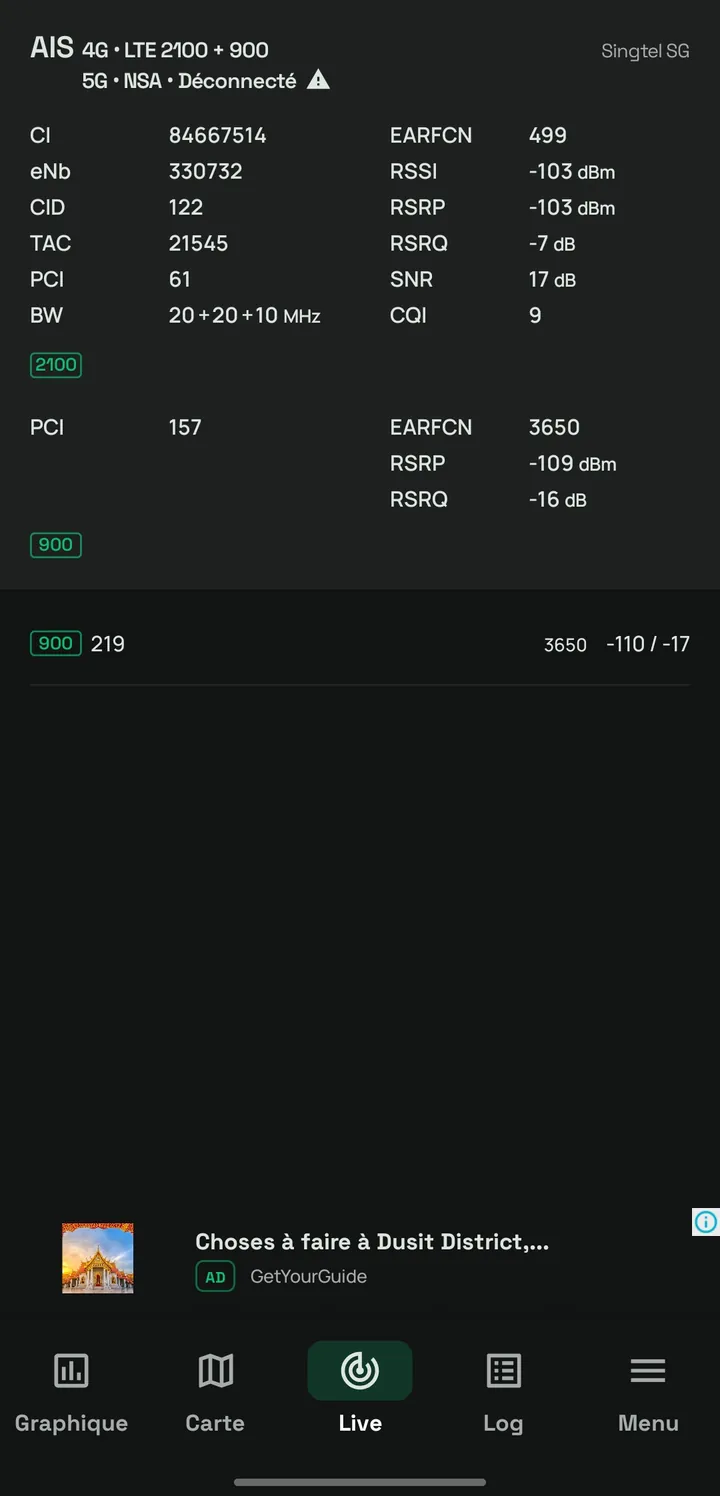
Ubigi attached to AIS in all 14 recorded observations. Yesim mainly attached to dtac. Other profiles moved between operators. These counts describe the campaign, not a nationwide coverage comparison.
Two profiles from one seller can behave very differently
The campaign also compared a second historical configuration with the main Performance route. Both had an apparent Singapore exit, but the networks differed: AS45143, Singtel, for the main route and AS58453, China Mobile International, for the other architecture.
Two configurations at the same locations
Download, Mbps. Main route: AS45143. Other architecture: AS58453.
Surat Thani
Other route: not measured.
Phunphin
Bangkok Lumpini
Bangkok Bangrak
Bangkok Sukhumvit
Bangkok Silom
Krabi
Ao Nang
Baan Na San
Tai Romyen
Tiger Cave
Nam Rad
At Ao Nang, the two download readings were 533 and 122 Mbps; at Nam Rad they were 93 and 98.1 Mbps. The main route was not higher at every location. The lesson is that a seller’s name alone does not describe the connection behind an eSIM.
The local network, cell, time, congestion and routing could change together. These pairs show differences between configurations; they do not establish an isolated routing effect.
Download and upload pairs, location by location
| Location | Main route: DL / UL (Mbps) | Other architecture: DL / UL (Mbps) |
|---|---|---|
| Surat Thani | 408 / 84.2 | Not measured |
| Phunphin | 226 / 74.5 | 59.3 / 44.8 |
| Bangkok Lumpini | 252 / 79 | 99.6 / 67.6 |
| Bangkok Bangrak | 243 / 73.8 | 98.6 / 47.2 |
| Bangkok Sukhumvit | 254 / 80.3 | 101 / 47.5 |
| Bangkok Silom | 248 / 12.8 | 98.6 / 11.7 |
| Krabi | 436 / 73.1 | 130 / 55.4 |
| Ao Nang | 533 / 70.4 | 122 / 12.4 |
| Baan Na San | 196 / 24 | 77.6 / 52.4 |
| Tai Romyen | 168 / 23.3 | 77.2 / 28.1 |
| Tiger Cave | 81.5 / 26.3 | 77.1 / 26 |
| Nam Rad | 93 / 1.35 | 98.1 / 55.6 |
Scroll sideways on smaller screens.
How we collected the measurements
Southern Thailand and Bangkok, 24 September to 1 October 2026. One Samsung Galaxy S23 FE (SM-S711B), Android 16; successive measurements at the same locations. Speedtest used the TCC Technology server in Bangkok, IPinfo recorded apparent IP geography and ASN, and NetMonster recorded the attached network.
Locations, retests and exclusions
The 16 physical locations, with Ao Nang and Ao Nang Beach treated as one place, were Bangkok Lumpini, Krabi, Surat Thani, Bangkok Silom, Bangkok Bangrak, Bangkok Sukhumvit, Phunphin, Baan Na San, Nam Rad, Ao Nang, Koh Yao Noi, Plai Phraya, Tai Romyen, Tiger Cave, Phang Nga Bay / boat, Klong Sai.
Bang Sue was excluded from every statistic and the location count because the wrong data line was active. One additional incomparable capture was discarded. The first Airalo Lumpini pass was in 3G (about 1.18 / 3.92 Mbps); the comparison uses the on-site 5G retest, 107 / 61.8 Mbps. The Performance readings at Krabi (436 / 73.1) and Ao Nang (533 / 70.4) were repeated later at the same location on the same phone.
DriftAsia publishes this research and sells eSIMs. The competing plans were bought and used as an ordinary customer. The complete 108-test corpus remains private; the 36-measurement comparison and the aggregates shown here are public. This is a limited campaign, not a national average or an exhaustive market test.
Choose for the task, and expect location to matter
This campaign found no all-purpose winner. Ubigi produced the highest single download; Saily combined the lowest median ping with the highest upload median in the direct comparison. The historical Performance profile stood out for consistently high downloads at the six common locations, with a 330 Mbps median and six readings above 200 Mbps.
For a traveller, the useful question is which behaviour matters for the trip: downloading media, sending large files, making calls or keeping a hotspot responsive. Local attachment and the international connection behind the eSIM both deserve attention. A headline Mbps figure does not describe the whole experience.
More from the Thailand eSIM field campaign
This study is part of our Thailand eSIM field campaign.

eSIM support
What five support teams said about top-ups and Internet routing.
Read the study →
Real-world validity
A two-day timeline separates installation, validity and first data use.
Read the study →
Purchase & installation
Five September purchases, with the current DriftAsia flow kept separate.
Read the study →All studies · Data Index · Programme methodology · Press and corrections
For journalists and researchers
In a September to October 2026 campaign, 108 valid tests covered 16 Thai locations. The direct comparison used 36 measurements at six common locations; no provider led every metric.
Citation: DriftAsia, We tested six travel eSIMs in Thailand. Published 8 October 2026; editorial revision 9 October 2026. Keep the sample, historical dates and evidence qualifications when quoting these findings.
Source field record: the final French-language campaign report published by our sister site. This English edition keeps the historical observations separate from current DriftAsia offers.
Adapted original text and tables: CC BY 4.0 with attribution and a link to this article. Third-party documents, screenshots and trademarks retain their own rights.