We asked five eSIM providers how their Thailand plans work
The same top-up and routing questions produced refused details, partial explanations and qualified answers. Here is what each exchange established.
Historical observations: September 2026 · One Android phone

The short version
- Topping up can mean waiting or replacing. The reported rules differed, including what happens to unused data.
- A country plan does not promise a same-country IP. Several replies described international infrastructure; one provider declined the detail.
- Reply speed and technical detail were separate. Immediate answers were not always complete, and a human handoff did not remove every uncertainty.
First question: what happens to the plan already in use?
We asked what happens when a customer buys a top-up before the current package runs out or expires. Does it queue, start at once, extend the old plan or replace it? That distinction matters if data or days remain.
| Provider | What the support exchange reported |
|---|---|
| Airalo | Next package waits until the current package ends, according to the recorded exchange. |
| Saily | A separate package waits under the same eSIM. |
| Nomad | A waiting add-on, according to tester notes; image attribution remains uncertain. |
| Ubigi | The next package waits; unused data is not carried over. |
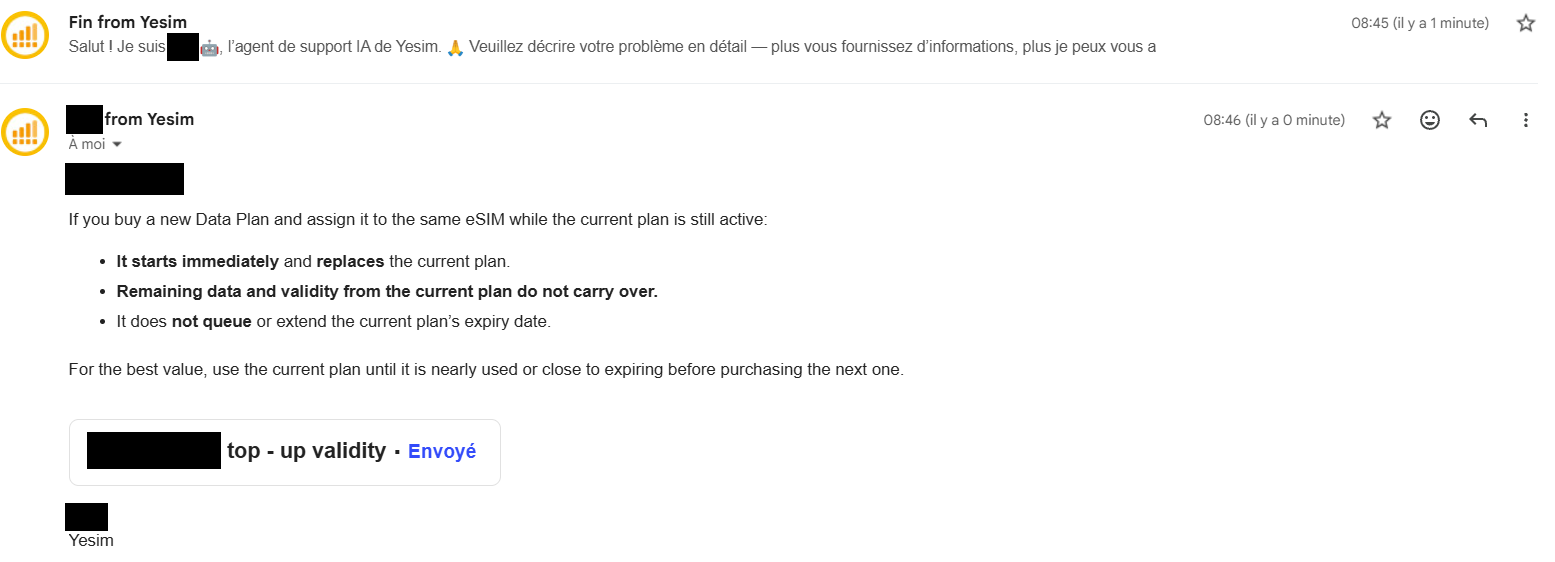
| Yesim | Immediate start and replacement of the active package, according to the AI reply. |
Scroll sideways on smaller screens.
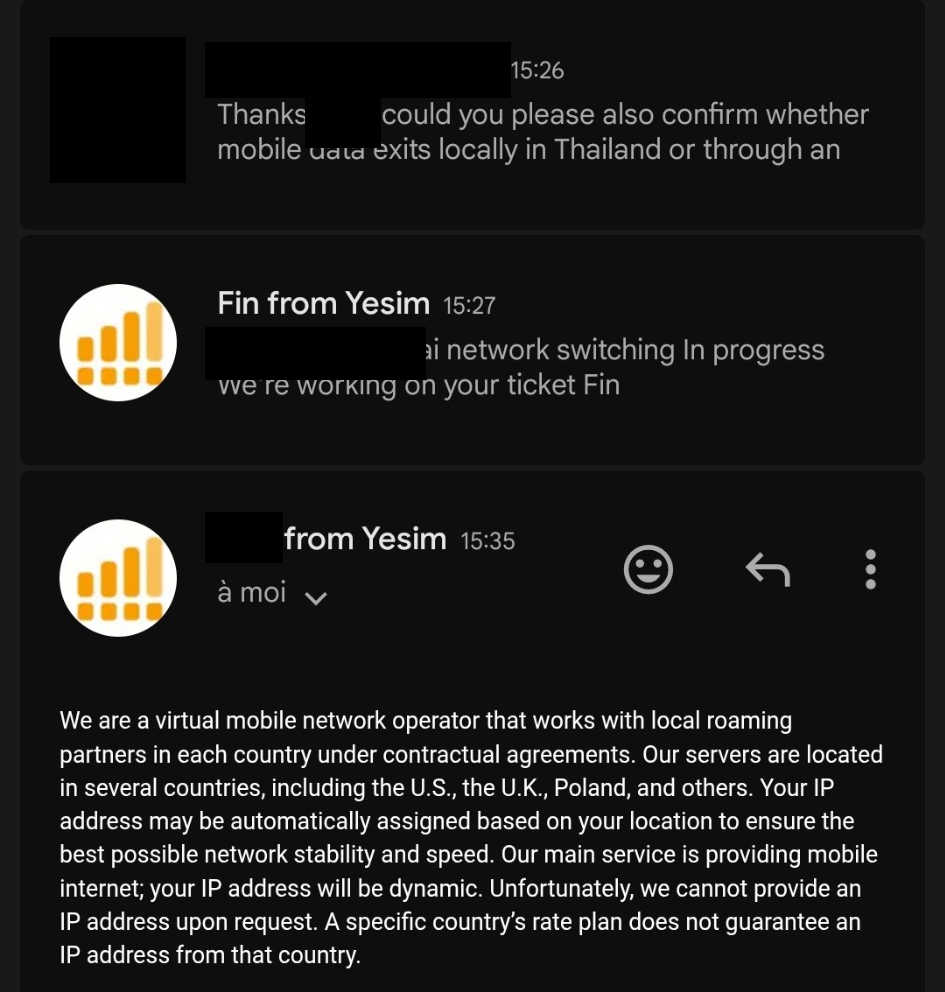
These are support statements about particular plans. We did not buy a competitor top-up to verify the behaviour. Yesim’s explicit AI response is shown below; an AI label is not itself a reason to accept or reject the answer.
Second question: does the traffic exit in Thailand?
We then asked whether mobile data reached the Internet locally in Thailand or through an international gateway. Knowing the difference can help a customer understand an unexpected IP location. A support reply still cannot independently prove the route taken by packets.
Airalo: a limit on disclosure
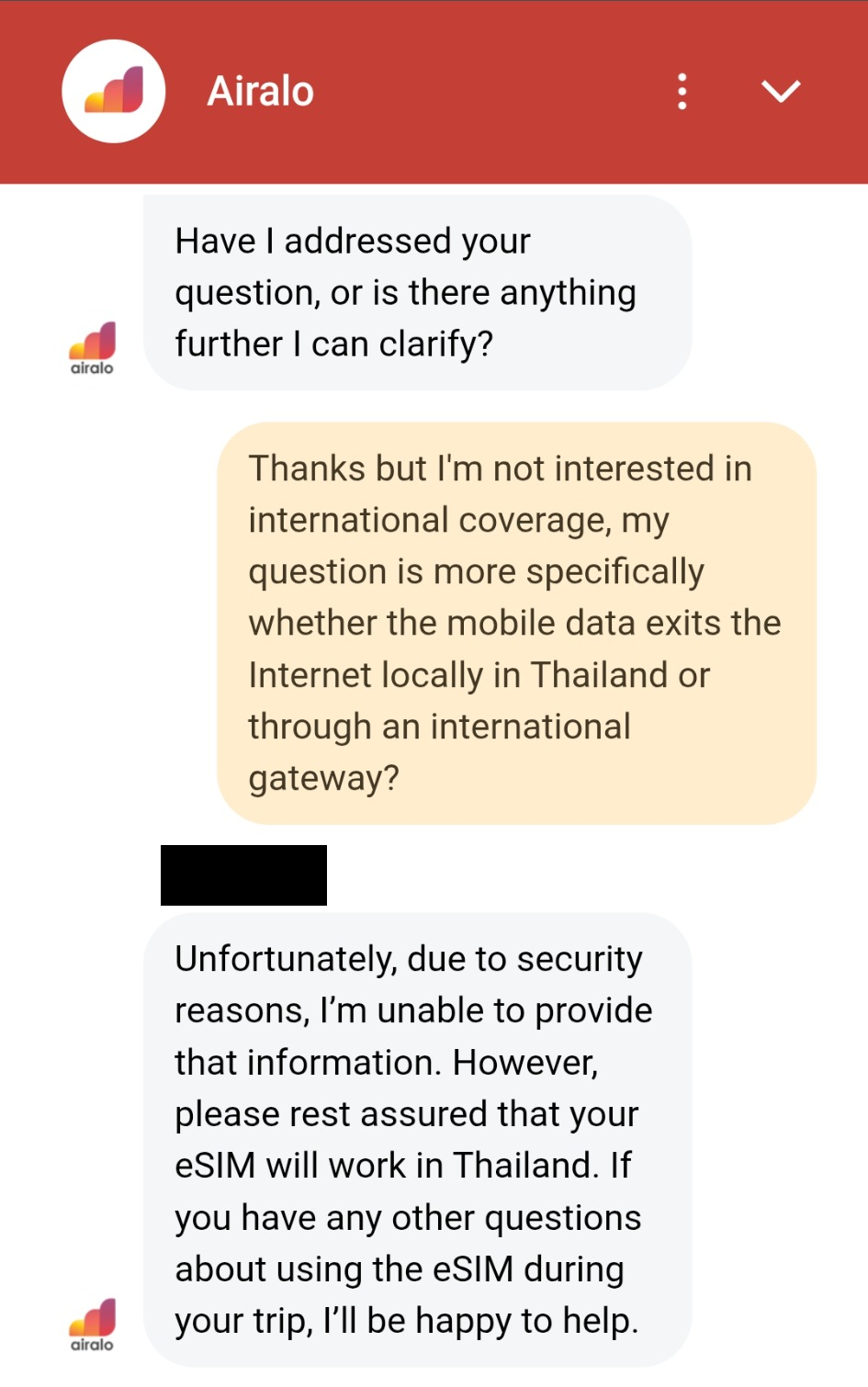
After escalation, Airalo declined to specify the routing for security reasons. The reply confirmed that the service would work in Thailand, but did not identify a local or international exit. That leaves the technical question unanswered.
Saily: an architecture explanation, not an exact exit
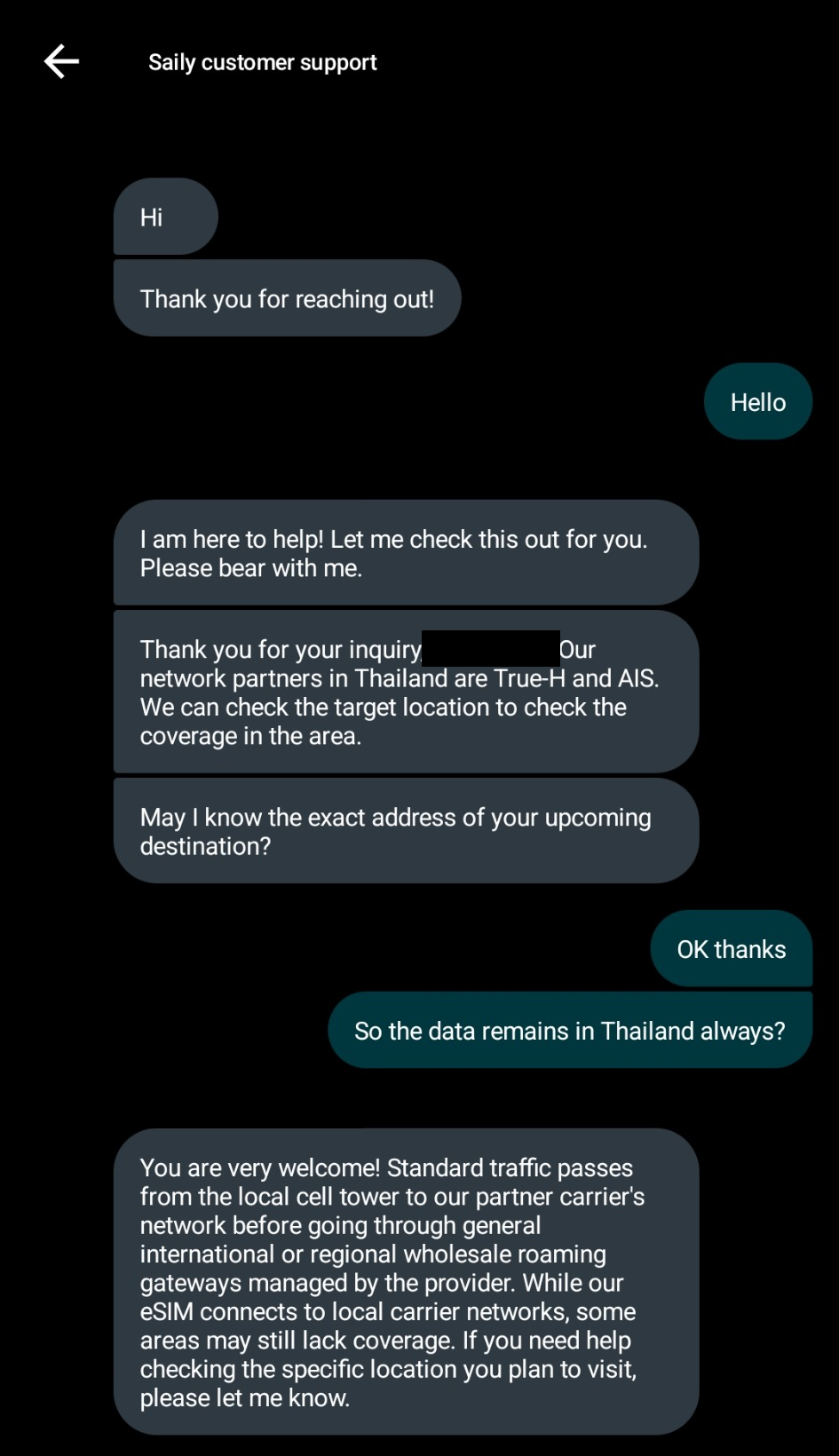
Saily described traffic passing through international or regional wholesale roaming gateways. This explained a general roaming model, but did not name the exact breakout for the tested plan. The answer was useful and partial.
Ubigi: a detailed answer with a qualification
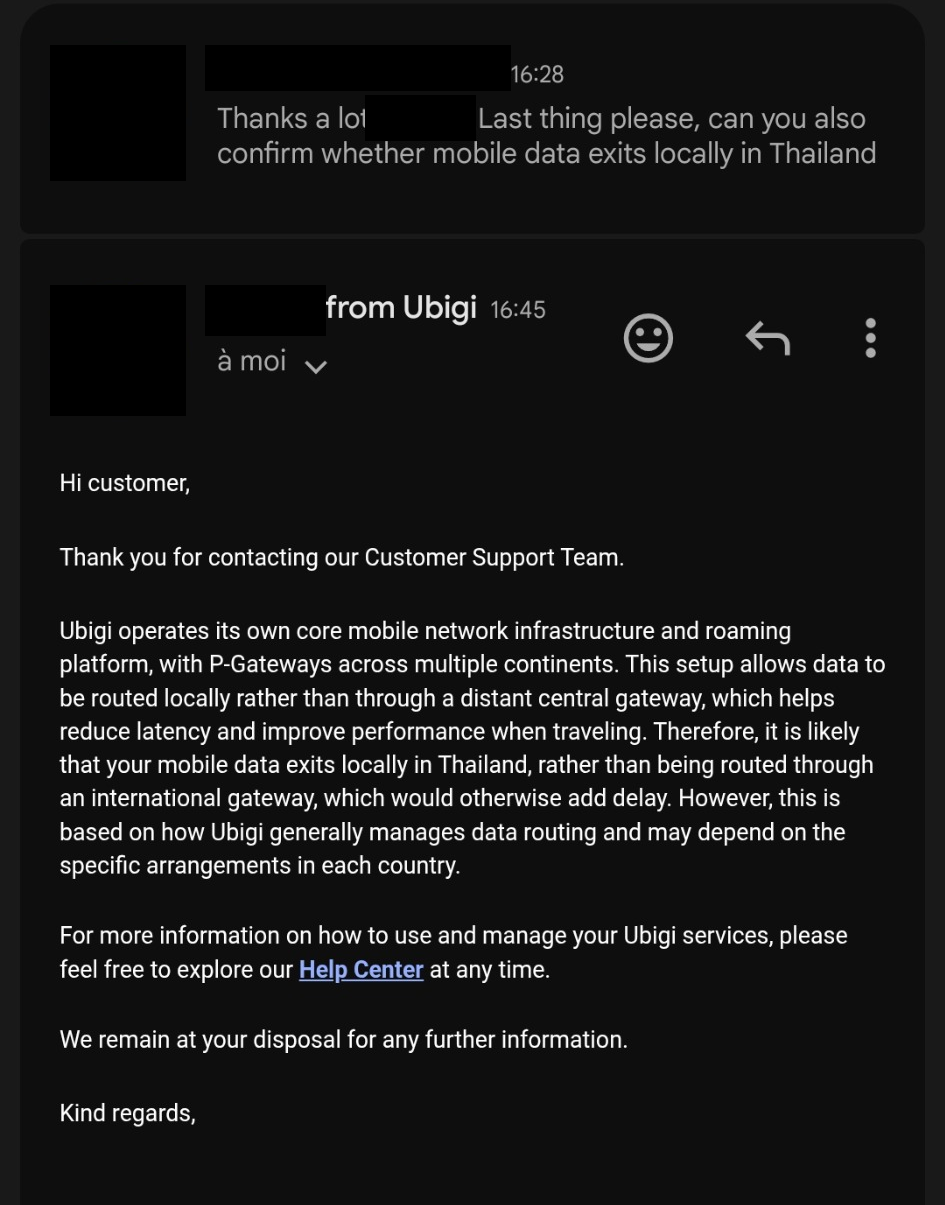
Ubigi explained its own core and roaming platform, with P-Gateways across continents. It said a local exit in Thailand was likely and might depend on country agreements. Those qualifications matter: the email did not confirm the physical exit of our session.
Yesim: a country plan and its IP are different things
Yesim described a virtual mobile operator model, local roaming partners, servers in several countries and dynamic IP assignment. Its answer did not guarantee that a Thailand plan would have a Thai IP.
Nomad: what the historical notes establish
The tester’s notes record an initial explanation of international routing, followed by a qualification that the exact breakout was not published for each individual plan. No Q2 screenshot is available for this edition. This entry therefore remains a note from the exchange, not a visually verified reply.
An immediate answer and a useful answer are different
| Provider | Contact and response | Timing recorded by the tester |
|---|---|---|
| Airalo | Live chat; AI, then a signed support reply | About 2 min to the first human recorded; about 20 min on Q2 |
| Saily | In-app chat; AI-to-agent handoff | Almost immediate handoff; about 10 min exchange |
| Nomad | Chat; AI according to the notes | Immediate; no human intervention recorded |
| Ubigi | Email; signed replies | Q2: about 1 h 08, then about 18 min for a follow-up |
| Yesim | Email / ticket; explicit AI on Q1, signed reply on Q2 | Q2: about 7 min, then about 9 min for a follow-up |
Scroll sideways on smaller screens.
The steps timed were not identical: first human contact, first reply and a technical follow-up are different events. Ubigi’s separate Q1 episode was recorded at about 8 h 25, distinct from its quicker Q2 exchange. The visible Ubigi Q2 excerpt runs from 16:28 to 16:45; Yesim shows one question and reply from 15:26 to 15:35.
A signature or avatar does not independently establish human authorship. Nor does an AI response have to be less accurate. The useful distinction is what the answer resolves, what needs clarification and what remains unknown.
Why these answers matter before a top-up
A customer deciding whether to top up needs a plan-specific answer about the remaining balance and the next start date. A customer trying to understand latency needs more than the name of a local Thai operator. The two questions test different kinds of clarity, so there is no single support score here.
For observed IP locations, ASN and attached networks, see the speed and routing study. Measurements and support explanations are kept separate.
How we asked, and what we can conclude
The Airalo, Saily, Nomad, Ubigi and Yesim plans were bought and used as an ordinary customer during the Thailand campaign. DriftAsia is our own service, so our customer support was excluded from this comparative assessment.
Read the two questions in full
Q1: topping up
Hi, I have a Thailand eSIM already installed. If I buy a top-up before the current data package is fully used or expired, what exactly happens to the remaining data and validity? Does the top-up start immediately, queue until the current package ends, extend the expiry date, or replace the current package? Could you please check this for my specific Thailand eSIM? I need an exact answer before topping up please.
Q2: Internet exit
Can you also confirm whether mobile data exits locally in Thailand or through an international gateway?
One exchange per provider is not a measure of all its customer service. Times are approximate notes or visible excerpts, not an average or a service guarantee. Nomad’s Q1 image could not securely establish the brand and is excluded; the Q1 text and Q2 entry remain qualified tester notes. The other five images retain their original interface language and anonymisation.
The most useful reply makes its limits clear
The exchanges ranged from a refusal to disclose routing, to a general gateway explanation, to a more detailed answer with explicit qualifications. The material shows differences in the answers obtained, without turning one support episode into a verdict on a whole company. Precise top-up rules and honest limits are more useful than an artificially confident answer.
More from the Thailand eSIM field campaign
This study is part of our Thailand eSIM field campaign.

Speed & networks
Speed, latency and Thai networks, compared across six common locations.
Read the study →
Real-world validity
A two-day timeline separates installation, validity and first data use.
Read the study →
Purchase & installation
Five September purchases, with the current DriftAsia flow kept separate.
Read the study →All studies · Data Index · Programme methodology · Press and corrections
For journalists and researchers
Five eSIM providers answered the same top-up and Internet-breakout questions. The replies ranged from refused details to partial explanations and qualified technical answers.
Citation: DriftAsia, We asked five eSIM providers how their Thailand plans work. Published 8 October 2026; editorial revision 9 October 2026. Keep the sample, historical dates and evidence qualifications when quoting these findings.
Source field record: the final French-language campaign report published by our sister site. This English edition keeps the historical observations separate from current DriftAsia offers.
Adapted original text and tables: CC BY 4.0 with attribution and a link to this article. Third-party documents, screenshots and trademarks retain their own rights.