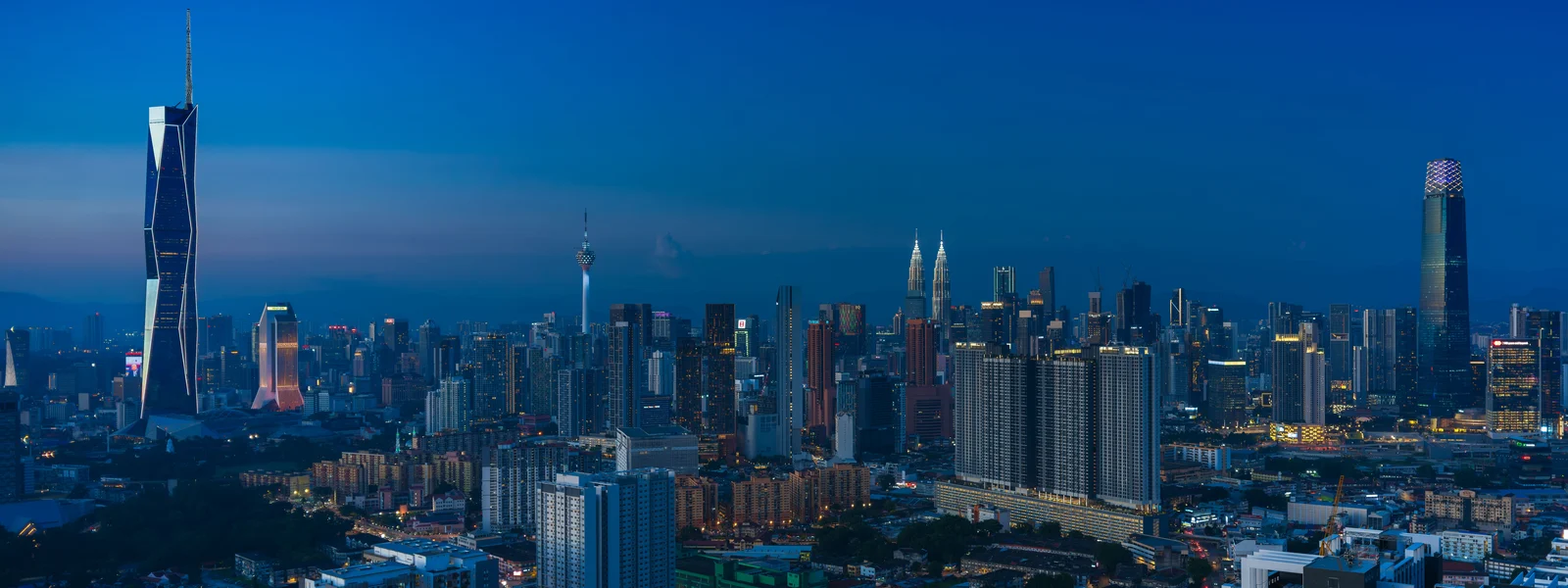
Malaysia 5G & 4G coverage in 2026
Malaysia shut down its 3G network entirely in 2022, making it one of the few countries in Southeast Asia where the minimum standard is 4G everywhere a tower exists. The country's 5G rollout has taken an unusual path: a wholesale network built by Digital Nasional Berhad (DNB) that all operators access equally, meaning 5G coverage in Malaysia is identical regardless of which operator your eSIM uses. The differences between operators in 2026 are in 4G depth, reliability, and rural reach.
The 5G question in Malaysia is not which operator to choose. It is where 5G exists. The 4G question is more nuanced, because CelcomDigi's rural reach into Sabah, Sarawak, and the Cameron Highlands is meaningfully better than its competitors.
The operator landscape after the mergers
Malaysia's mobile market has consolidated significantly since 2022. The merger of Celcom and Digi created CelcomDigi, now the country's largest operator by coverage breadth. Maxis, trading as Hotlink for prepaid, remains the reliability leader with an Opensignal Reliability Experience score of 874 points as of November 2025. U Mobile launched its own 5G Standalone network in August 2025, targeting 80% population coverage by the second half of 2026, and leads the market on 5G availability at 57.8%. Unifi Mobile rounds out the market as a strong urban performer. The practical consequence for travellers is that the three main networks available through international eSIM plans, CelcomDigi, Maxis, and U Mobile, each have distinct strengths that map to different itinerary types.
Malaysia eliminated 3G in 2022 under its National Digital Network (Jendela) initiative. Every tower in the country now runs at minimum 4G. This is a meaningful baseline: even in areas where signal is weak, the connection that exists is 4G rather than the slower 3G that would have been the fallback in previous years. The average 4G download speed nationally was approximately 32.7 Mbps as of the latest Opensignal measurements, with 5G averaging around 237 Mbps across the DNB wholesale network. These are not Vietnam's 617 Mbps or Singapore's ultra-fast speeds, but they are fast enough for every standard travel use case including video calls, navigation, and social media without any meaningful constraint.
| Operator | 4G coverage | 5G availability | Strength |
|---|---|---|---|
| CelcomDigi | 94 to 96% population | Via DNB wholesale network | Best nationwide rural reach. Strongest in Sabah, Sarawak, Cameron Highlands, Langkawi. |
| Maxis (Hotlink) | 94 to 96% population | Via DNB wholesale network | Best reliability score (874 pts Opensignal). Excellent urban performance. Strong in Peninsular Malaysia. |
| U Mobile | ~90% population | Own 5G SA network (57.8% availability) | Best 5G availability. Solid cities. Weakest in rural areas and Borneo. |
The 5G situation: one network, all operators
Malaysia's 5G architecture is unique in Southeast Asia. Rather than each operator building its own 5G network, a single wholesale provider called Digital Nasional Berhad built the national 5G infrastructure and all operators access it equally. The practical implication for travellers is that 5G coverage in Malaysia is determined by DNB's rollout map, not by which operator your eSIM uses. CelcomDigi on 5G and Maxis on 5G deliver identical coverage and similar speeds because both are roaming on the same underlying DNB network.
The exception to this is U Mobile, which launched its own independent 5G Standalone network in August 2025. U Mobile's network targets 80% population coverage by the second half of 2026 and leads the market on 5G availability as a result. For travellers specifically interested in 5G access in urban areas, a U Mobile routed eSIM offers the broadest 5G availability. For coverage in rural areas, Borneo, and remote destinations, CelcomDigi's superior 4G infrastructure matters more than 5G access, since 5G is concentrated in urban centres regardless of operator.
The national 5G average speed of approximately 237 Mbps is a real-world figure measured across all conditions. In optimal 5G zones in Kuala Lumpur and Penang, speeds reach 300 to 500 Mbps. In coverage fringe areas, 5G devices fall back to 4G automatically. For most travel use cases, the practical difference between strong 4G at 50 Mbps and 5G at 237 Mbps is not perceptible in daily tasks. Navigation, WhatsApp, social media, and video calls run identically well on either.
Kuala Lumpur and the Klang Valley
Kuala Lumpur and its surrounding Klang Valley metropolitan area have the densest mobile infrastructure in Malaysia. Both CelcomDigi and Maxis deliver consistent 4G throughout the city, with 5G active in commercial and tourist zones including the KLCC area, Bukit Bintang, Bangsar, and along the LRT and MRT corridors. Underground LRT stations have 4G throughout. The MRT Putrajaya Line, opened in 2023, has signal in stations and reasonable coverage in the underground tunnel sections. Brickfields, Chow Kit, and the older commercial neighbourhoods maintain strong 4G. The suburban fringe of the Klang Valley, including Shah Alam, Petaling Jaya, and Subang Jaya, all have strong multi-operator coverage.
KLIA and KLIA2 have excellent coverage throughout terminals and the Ekspres Rail Link connecting them to the city. Arriving passengers can rely on eSIM activation working immediately in the terminal. The KLIA Ekspres train maintains 4G throughout the route, including in tunnels, making it one of the more connected airport rail links in the region.
Penang: the northern tech hub
Penang is Malaysia's second major connectivity hub, with strong 4G across George Town and the surrounding industrial and residential areas. The UNESCO heritage zone of George Town has reliable multi-operator 4G, with 5G available in the commercial areas. The Penang Hill funicular ride, which ascends to 830 metres, has reasonable signal at the base and summit stations and intermittent coverage on the hillside sections. Butterworth on the mainland, connected to Penang island by ferry, has strong Maxis and CelcomDigi coverage. The 25-minute ferry crossing between Butterworth and George Town is partially offshore and has variable signal, recovering on approach to either pier.
Cameron Highlands and hill station routes
Cameron Highlands is one of Malaysia's most visited domestic destinations and a meaningful test of highland connectivity. The mountain road from Tapah to Tanah Rata climbs through terrain that challenges tower placement. CelcomDigi leads on coverage in the highlands specifically, with the best signal in Tanah Rata, Brinchang, and the main market areas. Maxis follows. U Mobile is notably weaker in Cameron Highlands than its urban performance would suggest, reflecting its lower investment in rural infrastructure.
Within Cameron Highlands, coverage at the main tourist attractions is functional but variable. The tea plantations, particularly BOH Tea Garden at Sungai Palas, have intermittent Maxis and CelcomDigi signal. The strawberry farms along the main road have reasonable coverage. The jungle trekking routes departing from Tanah Rata lose signal progressively as they move into the forest interior. The mossy forest above Brinchang has no mobile coverage. Download offline maps of the highlands before arriving. The road up from Tapah itself has dead zones on the most serpentine sections before reaching the plateau.
Langkawi: island coverage that works
Langkawi has better mobile coverage than most Malaysian islands of comparable remoteness, reflecting its status as a major international tourist destination with corresponding infrastructure investment. CelcomDigi leads the island in coverage breadth, with good 4G across Kuah town, Pantai Cenang, Pantai Tengah, and the main resort strip on the northwest coast. Maxis is strong in the same areas. The cable car to Gunung Mat Cincang loses signal at the middle station and has none at the summit. The Kilim Geoforest Park mangrove boat tours have patchy signal depending on how far the boat travels from the main channels.
The ferry crossing from Kuala Perlis or Kuala Kedah on the mainland to Langkawi takes one to two hours and is offshore for most of the journey. Download offline maps of Langkawi before boarding. The island's west coast road and the interior cross-island routes have occasional gaps. The duty-free shopping centres and main tourist areas have consistent coverage.
East Malaysia: Sabah and Sarawak on Borneo
East Malaysia, comprising Sabah and Sarawak on the island of Borneo, has seen significant coverage improvement under the Jendela initiative but remains the area where operator choice matters most. CelcomDigi has the strongest network in both states, consistently outperforming Maxis and dramatically outperforming U Mobile in rural Borneo. Kota Kinabalu in Sabah and Kuching in Sarawak both have strong multi-operator 4G in their urban areas. Moving outside these cities, the infrastructure thins and operator differences become pronounced.
The Kinabalu Park area and Mount Kinabalu approaches have CelcomDigi and Maxis 4G in Kundasang and at the park headquarters. Signal weakens significantly on the mountain trails above the treeline. The summit at 4,095 metres has no reliable coverage. Sepilok Orangutan Rehabilitation Centre near Sandakan has CelcomDigi coverage in the visitor centre area. The Kinabatangan River wildlife corridor, one of Borneo's premier wildlife experiences, has Telkom Malaysia broadband at some lodges and very limited mobile coverage in the river zone itself. Danum Valley, the primary destination for birding and wildlife in old-growth Borneo rainforest, has no mobile signal from any operator. The field centre has satellite-based communication for emergencies, but mobile data is absent entirely.
The Perhentian Islands and east coast islands
The Perhentian Islands off Terengganu are among Malaysia's most popular dive and beach destinations and among its most connectivity-challenged tourist areas. The crossing from Kuala Besut takes approximately 45 minutes with a significant offshore dead zone. On the islands themselves, coverage is available in the main village areas on Perhentian Kecil but is generally weak and unreliable. Charging phones at guesthouses and using WiFi at accommodation is the practical connectivity approach on the Perhentians. Mobile data should be treated as supplementary rather than primary. The Redang Island group has slightly better coverage at its main resort area but follows the same pattern. The Tioman Island crossing from Mersing takes two to four hours with extended offshore dead time, and on-island coverage is concentrated at the main ferry arrival points.
For Kuala Lumpur and Peninsular Malaysia cities: any of the three main operators delivers excellent connectivity. Maxis leads on reliability. For Cameron Highlands, Langkawi, and rural Peninsular: CelcomDigi has the broadest coverage. For Sabah, Sarawak, and Borneo wildlife destinations: CelcomDigi is the essential choice. Most international eSIM plans route through CelcomDigi or Maxis for Malaysia, which is the correct default for any itinerary that goes beyond the city centres.
Plans for Malaysia
Malaysia eSIM plans
Prices in USD. Instant QR activation. Pick your data, land connected.
FAQ
Which Malaysian operator has the best coverage for tourists?
CelcomDigi for any itinerary that includes rural areas, Cameron Highlands, Langkawi, Sabah, or Sarawak. Maxis for reliability in Peninsular Malaysia cities. U Mobile for best 5G availability in urban areas. For Borneo and remote wildlife destinations, CelcomDigi is the only operator with meaningful rural infrastructure.
Is 5G available throughout Malaysia?
No. 5G is concentrated in urban centres via the DNB wholesale network shared by all operators. U Mobile has the widest 5G availability at 57.8% from its own 5G SA network launched August 2025. Outside Kuala Lumpur, Penang, and major cities, 4G is the realistic standard. Average 5G speed is around 237 Mbps, 4G around 32 Mbps.
Is there signal in Cameron Highlands?
Yes in town, variable on highland trails. CelcomDigi leads coverage in Tanah Rata and Brinchang. The tea plantation routes and strawberry farm areas have intermittent signal. Jungle trekking routes lose coverage progressively. The mossy forest above Brinchang has no signal. Download offline maps before arriving.
Is there coverage in Sabah and Sarawak?
In cities yes, in wildlife areas it depends. Kota Kinabalu and Kuching have strong 4G. CelcomDigi is the best operator for rural Borneo. Danum Valley has zero coverage from any operator. Kinabatangan River has very limited signal. U Mobile is notably weak in East Malaysia.
Does Malaysia still have 3G?
No. Malaysia shut down its 3G network in 2022 under the Jendela initiative. All mobile coverage in Malaysia is now 4G or 5G. This means even in weaker coverage areas, the connection that exists runs on a 4G standard rather than slower 3G fallback.