eSIM for Palawan and El Nido 2026
Palawan is consistently ranked among the world's best islands, a designation it has earned through its extraordinary seascape of limestone karst formations, turquoise lagoons, and underwater biodiversity. Mobile coverage in Palawan follows the same logic as the island's development: solid in the cities, adequate in the tourist towns, and largely absent in the lagoons, sea caves, and open ocean that constitute the island-hopping experience.
Puerto Princesa: Palawan's gateway city and its coverage
Puerto Princesa is the capital of Palawan province and the main arrival point for travelers flying from Manila. The city has solid Globe 4G coverage throughout its urban area -- the airport, the main city center, the Rizal Avenue commercial strip, and the Puerto Princesa Subterranean River National Park area (the famous underground river about 80 kilometers north of the city) all have functional coverage. Download speeds in central Puerto Princesa on Globe typically run 15 to 25 Mbps, adequate for navigation, booking confirmations, and social media without frustration. The airport arrival experience at Puerto Princesa Airport is smooth for eSIM users -- the terminal has coverage and eSIM activation is immediate on landing.
Puerto Princesa is where most travelers handle the logistics of the Palawan trip: booking island-hopping tours, confirming El Nido accommodation, downloading offline maps for both the city and the northern destinations. The city's 4G is the last reliably fast connection before the road to El Nido, which takes 5 to 6 hours through varied terrain. Use Puerto Princesa's network deliberately before departing north. Every piece of information you will need for El Nido -- accommodation address and contact, tour booking confirmation, the El Nido town map, and the beach and lagoon guide for orientation -- downloads in minutes here. Doing it at a cafe in Puerto Princesa is categorically easier than trying to find signal midway through the northern road journey or on a tour boat in Bacuit Bay.
The Puerto Princesa to El Nido road: five hours with a coverage gradient
The road from Puerto Princesa north to El Nido follows the eastern coast of Palawan before cutting across the island's mountainous spine. The terrain ranges from coastal flat sections with good coverage to mountain passes where signal weakens significantly. The first 60 to 80 kilometers north of Puerto Princesa, along the coastal flat, have adequate Globe coverage with brief gaps. The mountain section in central Palawan -- approximately at the midpoint of the journey -- has the weakest coverage on the route, with some complete gap areas of 10 to 20 minutes. The approach to El Nido from the south has returning coverage as the road descends toward the coast. Vans on this route travel shared -- eight to ten passengers -- with occasional stops at towns along the way. The town stops (Roxas, Taytay) have coverage and are practical windows for a message sync during the journey.
| Road section | Coverage | Approximate duration |
|---|---|---|
| Puerto Princesa to Roxas | Good 4G with brief gaps | 2 hours |
| Roxas to Taytay | Adequate 4G, some gaps | 1.5 hours |
| Mountain section (Taytay to El Nido approach) | Weaker 4G, significant gaps | 1.5 hours |
| El Nido approach and town arrival | Returning adequate 4G | Final 30 min |
El Nido town: connectivity in the base camp for Bacuit Bay
El Nido town is a small beach settlement that has grown rapidly around its status as the departure point for island-hopping tours in Bacuit Bay. Globe has the strongest coverage in El Nido -- Smart is weaker on this specific part of Palawan. The main beach area (El Nido Beach), the town proper with its restaurants and guesthouses, and the boat departure areas all have adequate Globe 4G in the range of 10 to 20 Mbps. This is sufficient for booking tours, communicating with accommodation, posting photos from the beach, and the navigation needed to find restaurants and services in a small town. Streaming is possible but slower than in Manila or Puerto Princesa. Video calls work from a stationary position with good signal but are less stable than in the city.
El Nido's accommodation is concentrated in the town area and on the beaches south toward Corong-Corong. The Corong-Corong area, about 2 kilometers from the main town, has adequate coverage through the beach road. Nacpan Beach, the long beach about 17 kilometers north of town popular for day trips, has weak coverage that improves near the beach entrance and is minimal on the beach itself. For day trips to Nacpan, download the route before leaving El Nido town and treat the beach as offline territory.
Island-hopping tours: the offline reality of Bacuit Bay
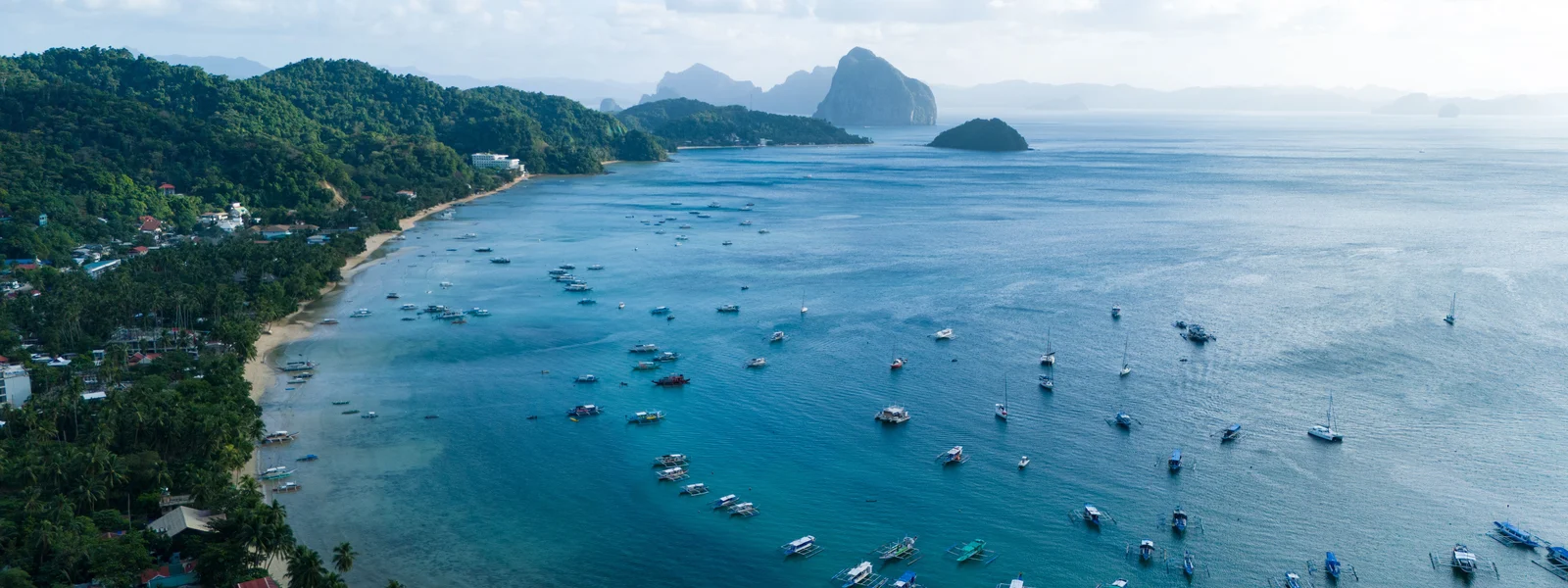
The island-hopping tours from El Nido are the reason most travelers make the journey to Palawan. Tour A covers the small and big lagoons, Secret Lagoon, and Shimizu Island. Tour B covers Entalula Island, Cathedral Cave, and the Snake Island sandbar. Tour C covers Helicopter Island, Star Beach, and Matinloc Shrine. Tour D covers Cadlao Lagoon, Nat Nat Beach, and Bukal Beach. All four tours involve travel on open wooden bangka boats between limestone karst formations, and all four share the same coverage reality: absent in open water, minimal near some of the more remote formations, and returning briefly when the boat passes close to the El Nido mainland.
The lagoons themselves -- the Big Lagoon, Small Lagoon, and Secret Lagoon that define El Nido's visual identity -- have no mobile coverage. They are enclosed by limestone walls that block signal in the same way that caves block signal. The experience of kayaking or swimming in these formations is completely offline, which is appropriate given the environment. Photographs taken in the lagoons upload when the boat returns to open water on the way back to El Nido. Planning this workflow in advance -- shoot in the lagoons, upload at the end of the tour -- is more satisfying than trying to post from a bobbing bangka in limited signal conditions.
Coron: the other Palawan destination
Coron, in northern Palawan's Calamian Island group, is a separate island-hopping destination known for World War II wreck diving and the Kayangan Lake. It is reached by ferry from Manila (overnight) or by short flight from Manila or Puerto Princesa. Globe coverage in Coron town is adequate for tourist needs. The lake, wrecks, and surrounding islands have the same open-water coverage pattern as El Nido: present near the town, absent at remote dive sites and in open water between islands. Coron is accessed through its own travel circuit rather than as an extension of El Nido travel -- the two are on opposite ends of Palawan and most travelers choose one or the other rather than attempting both in one trip.
Data needs for Palawan
A five to seven day Palawan trip (two days in Puerto Princesa, four to five days in El Nido) has a lower total data consumption than the equivalent time in Manila. Puerto Princesa days generate 1 to 1.5 GB of consumption. El Nido base days generate 0.8 to 1.2 GB. Tour days generate 200 to 500 MB -- the boat time is offline and the onshore time is brief. Total consumption for a week in Palawan might be 6 to 10 GB. Combined with a Manila gateway of 3 to 4 days at 2 to 3 GB per day, the full Philippines trip runs 15 to 22 GB for two weeks. A 20 GB plan covers this with marginal headroom; travelers who post actively or stream video should budget for a top-up or start with a larger plan.
Plans for Philippines
Philippines eSIM plans
Prices in USD. Instant QR activation. Pick your data, land connected.
FAQ
Does eSIM work in El Nido?
Yes, in town. Globe is the stronger network in El Nido and northern Palawan. The main beach area, town restaurants, and guesthouse district have adequate 4G at 10 to 20 Mbps. Island-hopping tours are offline in open water and in the enclosed lagoons.
Is there signal on El Nido island-hopping tours?
Minimal to none. The bangka boats are in open water between limestone formations where coverage is absent. The lagoons (Big Lagoon, Small Lagoon, Secret Lagoon) have no signal inside the limestone enclosures. Photos upload when the boat returns to El Nido town area at the end of the tour.
What is coverage like on the road from Puerto Princesa to El Nido?
Variable. Good 4G leaving Puerto Princesa, weakening through the mountain section in central Palawan, returning on the approach to El Nido. Total journey is 5 to 6 hours with the weakest coverage in the middle mountain section. Download El Nido information in Puerto Princesa before departing.
Globe or Smart for Palawan?
Globe is significantly stronger in Palawan, particularly in El Nido and the northern island area. If your eSIM connects to Smart, you will have weaker coverage in El Nido than a Globe-connected plan. Verify your provider's carrier before purchasing if Palawan is on your itinerary.
How much data do I need for Palawan?
6 to 10 GB for a 5 to 7 day Palawan trip. Puerto Princesa days run 1 to 1.5 GB. El Nido town days run 0.8 to 1.2 GB. Tour days generate very little eSIM consumption. Combine with Manila days (2 to 3 GB/day) when sizing your total Philippines plan.