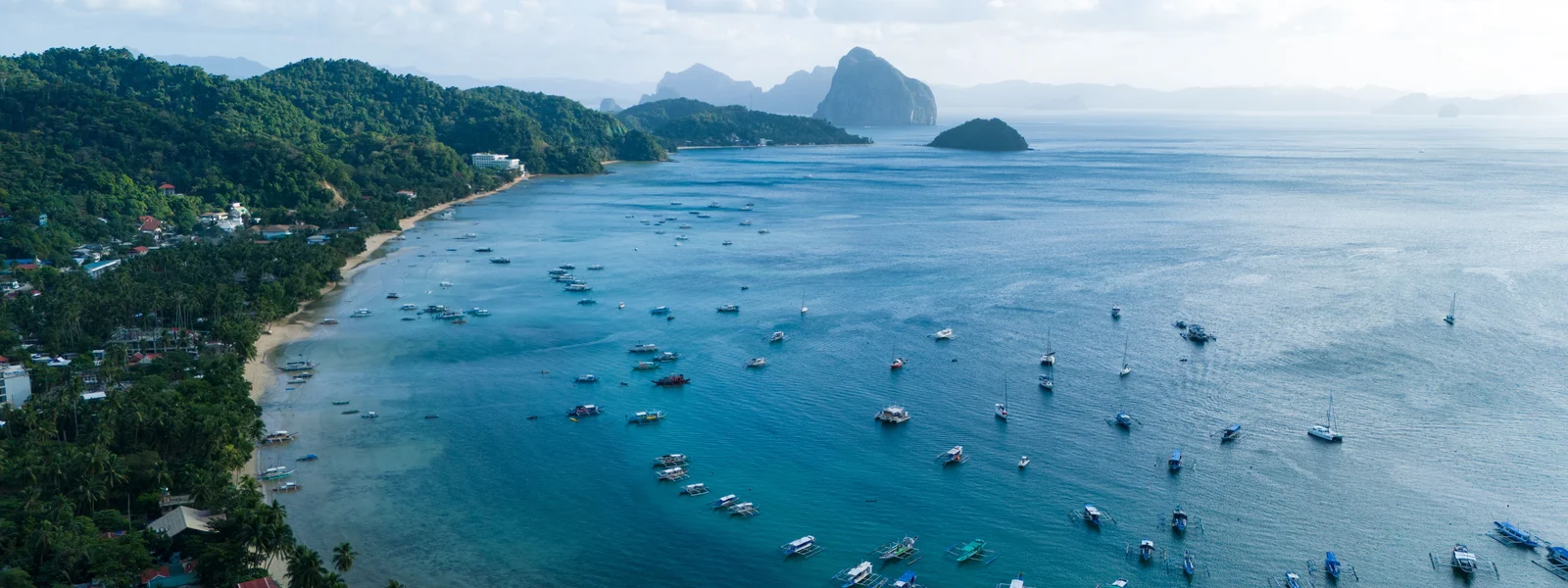
Island hopping the Philippines: eSIM guide 2026
Island hopping the Philippines means navigating an archipelago of over 7,000 islands across multiple ferry crossings, small airports, and van transfers through countryside with variable coverage. The data strategy that works is not about having unlimited data -- it is about using fast city 4G before each transition to download everything you need for the next destination, and accepting that the sea crossings themselves are offline time.
The island-hopping data pattern
A Philippines island-hopping trip creates a specific and predictable data consumption pattern. City days in Manila or Cebu run at 2 to 3 GB of eSIM consumption -- Grab, navigation, social media, and the app-mediated life of a dense urban environment. Ferry crossing days consume 50 to 300 MB total -- a burst of preparation data before boarding, near-zero during the crossing, and a burst of messaging and navigation on arrival. Island base days (at El Nido, Boracay, Siargao, or Panglao) run 0.5 to 1.5 GB on eSIM, with accommodation wifi handling evening heavy use. Island tour days -- the bangka boat trips between formations and lagoons -- consume 200 to 500 MB total from the morning preparation and evening upload, with the hours on the water genuinely offline.
This pattern means total eSIM consumption on a two-week Philippines trip is dominated by the Manila and Cebu days rather than the island days. A trip with 4 days in Manila, 2 days in Cebu, and 8 days across El Nido, Boracay, and Siargao might use 8 to 12 GB in Manila and Cebu and only 5 to 8 GB in the island destinations, for a total of 13 to 20 GB over the full trip. A 20 GB plan covers most such itineraries with moderate headroom. The common mistake is sizing the plan for the island experience and underestimating Manila.
| Day type | Typical eSIM use | Primary consumption drivers |
|---|---|---|
| Manila city day | 2 to 3 GB | Grab, navigation, Facebook, social posting |
| Cebu city day | 1.5 to 2.5 GB | Navigation, work, social; less Grab-dependent than Manila |
| Ferry crossing day | 0.2 to 0.5 GB total | Pre-boarding downloads, arrival messaging |
| Island base day | 0.5 to 1.5 GB | Maps, restaurant finding, social; wifi in evening |
| Island tour day (bangka) | 0.2 to 0.5 GB | Morning prep, evening upload; water is offline |
The pre-departure download routine for every island hop
The single most valuable connectivity habit for Philippines island-hopping is building a consistent pre-departure routine that executes before every ferry crossing or inter-island flight. The routine takes five minutes and eliminates every data-stress moment on the circuit. The specific items: download Google Maps offline tiles for the destination island or city, save accommodation address and contact number in a notes app, confirm any tours or activities booked for the destination (screenshot or PDF), note the relevant ferry return schedule if applicable, and send any messages that need timely delivery before signal is lost. This routine should happen in the last connected environment before the crossing -- the ferry terminal in Cebu, the van in Puerto Princesa before heading north to El Nido, the guesthouse in General Luna before the Siargao to Cebu flight.
The routine is not merely a data management technique -- it is a travel organization technique that produces a more relaxed arrival experience regardless of connectivity. Arriving in El Nido with your accommodation address and contact offline means the tuk-tuk transfer from the boat pier is organized and direct rather than improvised. Arriving in Tagbilaran with the Chocolate Hills tour details saved locally means the morning logistics of the Bohol day trip do not require a wifi connection to reconstruct. These preparations take five minutes before each crossing and save thirty minutes of frustration on arrival at destinations where wifi is slow and eSIM signal is moderate.
Facebook Messenger: the essential booking tool for the Philippines
The Philippines has one of the world's highest Facebook usage rates, and this cultural reality shapes how island-hopping tourism operates. Guesthouses, tour operators, bangka boat services, and local guides in El Nido, Siargao, Coron, and smaller Philippine islands all communicate primarily through Facebook Messenger. International booking platforms like Booking.com and Hostelworld are used for larger and more established properties, but for the smaller guesthouses and activity providers that define the island-hopping experience, Messenger is the operational system. A traveler who does not have Facebook Messenger installed and logged into an accessible account before arriving in the Philippines will find the booking and communication process consistently harder than it needs to be.
The practical consequence for eSIM data planning is that Messenger needs to work continuously throughout the island-hopping trip, not just in cities. Messenger is a low-bandwidth app for text communication -- a message exchange with an El Nido guesthouse about check-in time uses a few kilobytes. Where bandwidth matters is in loading the guesthouse's Facebook page to find the Messenger contact, which involves loading profile photos and recent posts. Do this on strong city 4G before arriving at a destination with weaker coverage, and save the Messenger contact to your phone's contact list so future communication goes directly to the conversation thread without requiring page loading.
Sizing your plan for a 2 to 3 week Philippines circuit
A two to three week Philippines island-hopping circuit covering Manila, one or two island groups (Palawan, the Visayas including Cebu and Bohol, and/or Mindanao destinations like Siargao), and a return through Manila or Cebu should be planned with a 20 to 30 GB eSIM plan. The 20 GB plan covers most two-week circuits for moderate data users who use accommodation wifi in evenings. The 30 GB plan provides headroom for heavier posting, streaming in accommodation, or working during the trip. Trying to complete a two-week Philippines island-hopping trip on a 10 GB plan requires consistent rationing and will produce at least one stressful data management moment. The Philippines is not a destination for tight data budgeting -- buy generously relative to what you think you need.
Using city stops as data banking opportunities
The city stops in Manila and Cebu that bookend or segment most Philippines island-hopping circuits are data banking opportunities -- moments of fast, reliable 4G or 5G where the downloads and preparations for upcoming island legs can be completed efficiently. The Manila layover on the return from Siargao to Palawan, the Cebu transit between Bohol and the Visayas ferry network, the Tagbilaran arrival with its adequate 4G before heading to Panglao Beach -- each of these connection points is where the traveler who plans ahead uses two minutes of fast data to prepare for the next offline period. Treating city stops as purely transitional rather than as preparation windows is the pattern that leads to underprepared island arrivals and data management stress.
Flight vs ferry: connectivity considerations
Many Philippine island-hopping circuits mix domestic flights with ferry crossings. Flights between Manila and Cebu, Manila and Puerto Princesa, Manila and Kalibo (for Boracay), and Cebu to Siargao are short (45 to 90 minutes) and have airplane mode required throughout. The advantage of flights over long ferry crossings is not just speed -- it is the compression of the offline period to a brief, predictable, and manageable window rather than a multi-hour crossing. On a flight from Manila to Puerto Princesa, the offline period is 90 minutes with a clear endpoint. On the overnight Manila to Puerto Princesa ferry, the offline period is 12 to 14 hours with less predictable connectivity windows. For data-dependent travelers or those with ongoing work commitments, flights between major Philippine destinations are the connectivity-conscious choice even when ferry options exist.
Plans for Philippines
Philippines eSIM plans
Prices in USD. Instant QR activation. Pick your data, land connected.
FAQ
How much data do I need for island-hopping the Philippines?
20 GB for a two-week circuit, 30 GB for three weeks. Manila days drive the total at 2 to 3 GB per day. Island days run 0.5 to 1.5 GB. Ferry crossing days use 0.2 to 0.5 GB total. Never size your plan only for the island days.
What should I download before each ferry crossing?
Offline Google Maps for the destination, accommodation address and contact saved locally, tour bookings confirmed, ferry return schedule noted, and time-sensitive messages sent before boarding. Five minutes of preparation in the departure port eliminates every data-stress moment on arrival.
Is Facebook Messenger necessary for Philippines island-hopping?
Effectively yes. Philippine island guesthouses, tour operators, and local guides communicate primarily via Facebook Messenger. International booking platforms work for larger properties; Messenger is the operational system for smaller island businesses. Install and log in before arriving.
Should I get a local Philippine SIM for island-hopping?
For trips over two weeks, a local Globe SIM from NAIA is worth considering -- better value than travel eSIM plans for long stays, and Globe's wider island coverage is the right default for island-hopping circuits. For shorter trips, travel eSIM convenience wins.
Is it better to fly or take ferries between Philippine islands for connectivity?
Flights compress the offline period to a predictable 90-minute window rather than a multi-hour crossing. For connectivity-conscious or work-active travelers, flights between major Philippine destinations are the better choice when both options exist.