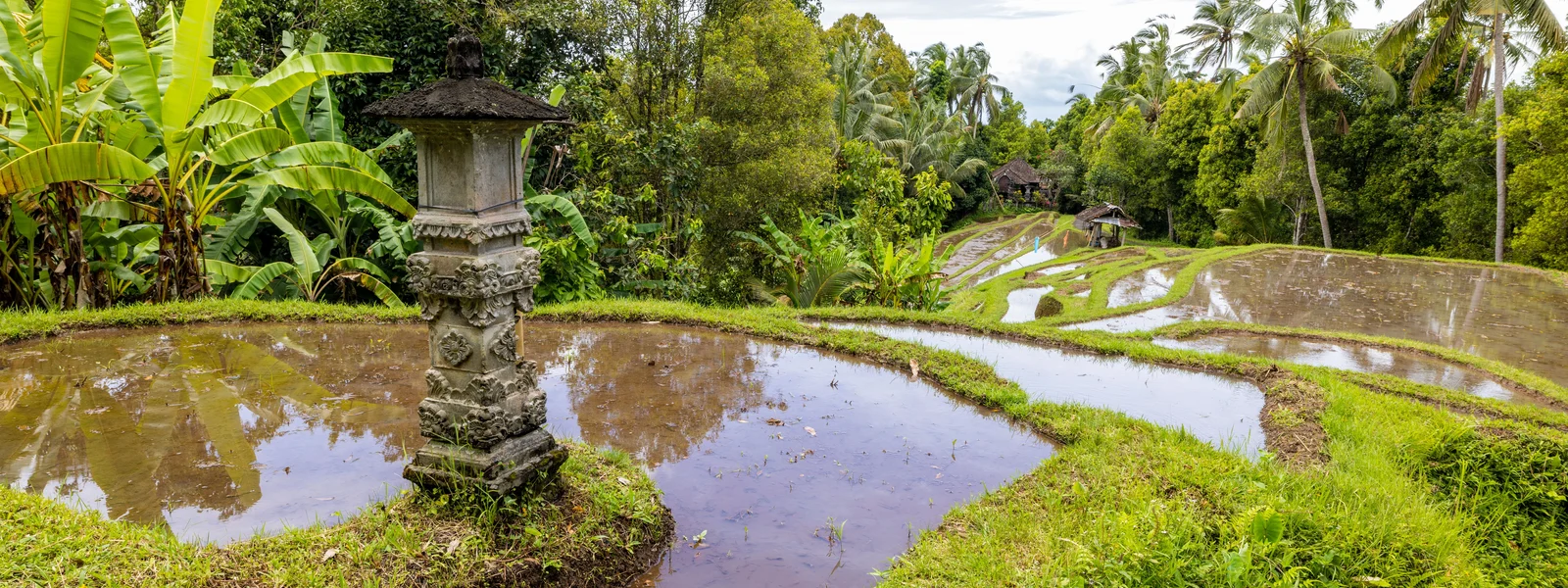
Indonesia 5G & 4G coverage in 2026
Indonesia is a mobile network story told in two completely different registers. On Java and Bali, and in the major cities of Sumatra, Sulawesi, and Kalimantan, Telkomsel delivers 4G coverage to over 97% of the population and 5G in 56 cities. In Raja Ampat, on the open water between islands, and in the highland interior of Flores, the network simply does not exist. Both registers are true simultaneously, and knowing which one applies to your specific route is the only planning that matters.
Indonesia has 17,000 islands. A coverage percentage that sounds national is measured against the population, not the geography. Where people are dense, coverage is dense. Where the ocean is, the coverage is not.
The three operators and what the 2024 merger changed
Indonesia's mobile market settled into its current structure in 2024 following the merger of XL Axiata and Smartfren into a single entity called XLSmart. Before the merger, four operators competed in a fragmented market. After it, three operators hold roughly distinct positions: Telkomsel as the clear leader on coverage and scale, Indosat Ooredoo Hutchison (IOH) as the second network with approximately 94.7 million subscribers, and XLSmart as the third with 94.5 million subscribers but a stronger urban than rural footprint. For a traveller, the consolidation has simplified the choice: Telkomsel for any itinerary that goes beyond Java and Bali, and any of the three for travel confined to those main islands.
Telkomsel holds the coverage leadership by a significant margin. Its 4G LTE network operates across all 38 Indonesian provinces and covers over 97% of the population. Its Hyper 5G network, deployed across 56 cities and regencies as of 2026, achieves median 5G download speeds of 88 Mbps and peak speeds exceeding 610 Mbps in optimised Hyper 5G zones, according to Ericsson and Telkomsel's joint network data published in June 2025. Indosat IOH offers a competitive alternative for price-sensitive users on Java and Sumatra but has less rural depth. XLSmart delivers strong performance in urban and tourist-heavy areas including Bali and central Java, with competitive pricing, but thins significantly in eastern Indonesia and rural regions.
| Operator | 4G population coverage | 5G cities (2026) | Best for |
|---|---|---|---|
| Telkomsel | 97%+ | 56 cities and regencies | Any itinerary beyond Java and Bali. Only viable operator in eastern Indonesia and remote destinations. |
| Indosat IOH | ~85% (Java and Sumatra strong) | Major cities only | Java, Sumatra urban areas. Price-competitive alternative where Telkomsel's premium is not needed. |
| XLSmart | ~85% (Java, Bali, Lombok strong) | Jakarta, Bali, Surabaya | Bali and Java tourist corridor. Strong 5G video streaming performance in covered areas. |
Bali: good coverage with specific gaps
Bali is the most-visited destination in Indonesia and has coverage that reflects that status. Telkomsel 5G is active in the main tourist areas of Denpasar, Kuta, Seminyak, and Ngurah Rai airport. The airport strip itself has blanket 5G coverage throughout. Real-world 5G speeds in these zones reach 200 to 400 Mbps download according to measured data, with 4G fallback across the rest of the island. Canggu has partial 5G with consistent 4G. Ubud, Uluwatu, and most of the island's interior operate on 4G only. The geography of Ubud's valleys and Uluwatu's clifftops makes tower placement difficult, and 5G infrastructure investment there has lagged the coastal tourist strip. Nusa Lembongan has 4G, with 5G expected in 2026 per Telkomsel's infrastructure roadmap. Nusa Penida remains 4G-only through 2026 at minimum, with its geography making 5G rollout uncertain beyond that.
The inter-island crossings to Nusa Penida, Nusa Lembongan, and the Gili islands follow the same pattern as every Indonesian crossing: signal at the departure pier, dropping within two to three kilometres offshore, returning near the destination. The Gili islands off Lombok have Telkomsel 4G on Gili Trawangan and Gili Air, with Gili Meno having weaker signal. The boat crossings from Padang Bai or Sanur to the Gilis take one to two hours with a substantial offshore dead zone in the middle. Download offline maps and screenshot bookings before boarding any inter-island boat from Bali.
Java: Indonesia's most connected island
Java is home to Indonesia's largest cities and its densest mobile infrastructure. Jakarta has Telkomsel Hyper 5G in the main business and residential districts including Alam Sutera, Pantai Indah Kapuk, Kelapa Gading, and Pondok Indah, with 5G expanding through the capital's urban core. Surabaya, Indonesia's second city, has strong 4G throughout and 5G in central districts. Bandung has good 4G. Yogyakarta, the base for Borobudur and Prambanan temple visits, has reliable Telkomsel 4G throughout the city and at both temple sites. The Trans-Java highway corridor between these cities is well-covered, with only brief gaps at the most elevated mountain sections.
The notable coverage exceptions on Java are the volcanic highland areas. Mount Bromo's viewing platforms at the crater rim have Telkomsel signal that works for messaging and light browsing but can be inconsistent for sustained calls. The descent into the caldera and the hiking routes away from the viewpoints lose signal. Mount Ijen, the blue flame crater in East Java, has no signal at the crater itself due to elevation and the sulfuric gas environment. The access roads to both mountains have 4G in the lower sections dropping off progressively as altitude increases. Download offline maps of the approach routes before leaving the nearest city.
Nyepi 2026: Bali's mobile data shutdown
Nyepi, the Balinese Day of Silence, falls on Thursday 19 March 2026. From 6am on 19 March until 6am on 20 March, Bali observes a complete 24-hour stillness. Indonesia's Minister of Communication and Digital Affairs issued Ministerial Circular No. 2 of 2026 instructing all operators to suspend mobile data services across Bali for the full Nyepi period. This is not a partial throttle or a reduction in speed. It is a complete shutdown of cellular data on all operators on the island, confirmed in advance by Indonesian authorities.
What remains available during Nyepi is WiFi operating through fibre-optic connections, which authorities confirmed will stay active to support essential public services. Hotel and resort WiFi remains accessible. Mobile data does not. Voice calls on mobile networks may also be affected depending on operator implementation. The Ngurah Rai international airport closes completely for the 24-hour period, with no flights arriving or departing. Roads are empty and patrolled by pecalang, traditional Balinese security. Tourists and residents must remain in their accommodation. The evening before Nyepi, on 18 March, the Ogoh-Ogoh parade takes place across the island and is open to visitors. This is a significant and photogenic event worth planning around.
Sumatra, Sulawesi, and Kalimantan
The major cities of Indonesia's other large islands have strong 4G from Telkomsel and reasonable coverage from Indosat IOH. Medan in North Sumatra is well-covered. Makassar in South Sulawesi has Telkomsel 4G throughout and 5G in select zones. Balikpapan in East Kalimantan has strong 4G. These cities function as normal connectivity environments comparable to secondary cities on Java. Moving outside the cities, coverage becomes more dependent on Telkomsel specifically, and thins progressively with distance from main roads and population centres. The interior of Kalimantan, which includes the Orangutan rehabilitation sites around Tanjung Puting, has Telkomsel coverage in the town of Kumai and along the main river near Tanjung Harapan, with signal dropping on the longer klotok boat journeys into the national park interior.
Komodo, Flores, and eastern Indonesia
Labuan Bajo, the gateway town for Komodo National Park on the island of Flores, has Telkomsel 4G in town. The boat crossing from Labuan Bajo to Komodo Island and Rinca Island is an offshore dead zone. Komodo Island itself has no mobile coverage. The dragon viewing sites, the hiking routes, and the diving and snorkelling areas around Komodo are all offline. This is the destination where pre-trip preparation matters most: screenshot every booking, download offline maps of the national park, and inform contacts of the timeline before departure from Labuan Bajo.
The Trans-Flores Highway connecting Labuan Bajo to Ruteng, Bajawa, Ende, and Maumere has intermittent Telkomsel signal between towns, with gaps that can extend for 30 to 60 minutes of driving. Flores is one of Indonesia's most dramatically beautiful road trip routes and one of its most consistent dead zones outside the valley towns. The practical approach is identical to the Ha Giang Loop: download offline maps of the full route before departing any town, confirm the next accommodation by phone while signal is available, and treat the road sections between towns as offline periods with connectivity islands at each stop.
Raja Ampat: the most beautiful dead zone in Indonesia
Raja Ampat, the remote archipelago in West Papua widely considered the world's best diving destination, has essentially no mobile coverage. Sorong, the gateway city on the West Papua mainland, has Telkomsel 4G. The two to three hour ferry crossing from Sorong to Waisai, the main town on Waigeo Island, crosses open water with no coverage. Waisai town has limited Telkomsel signal. The dive resorts and homestays scattered across the archipelago's islands and bays are almost entirely without mobile coverage. WiFi at the better-equipped resorts is typically satellite-based and available on a limited basis. For most visitors, Raja Ampat is a scheduled digital detox of whatever duration their diving itinerary runs, typically one to two weeks.
This is worth knowing before departure rather than discovering on arrival. Contacts expecting regular communication need advance notice of the blackout period. Work commitments needing connectivity need to be resolved before the Sorong to Waisai crossing. Raja Ampat's appeal is entirely independent of mobile connectivity, but travellers who arrive expecting the kind of connectivity they have in Bali or Java will be significantly surprised.
Island ferries and the offshore dead zone rule
Indonesia's fundamental coverage rule is consistent across its 17,000 islands: offshore is offline. Signal drops within two to three kilometres of any departure pier and returns when the boat approaches its destination. The duration of the dead zone scales with the crossing distance. Short crossings from Bali to Nusa Penida take 45 minutes with 20 to 30 minutes offline. Longer crossings from Java to Bali by ferry take around five hours with most of that time offline. The Sorong to Raja Ampat crossing is two to three hours, mostly without signal. Every inter-island crossing in Indonesia should be treated as scheduled offline time regardless of operator or plan. Download everything before the pier and plan your communication around arrival rather than transit.
For Bali and Java: any of the three operators covers the tourist corridor adequately. XLSmart and Indosat IOH offer competitive pricing. Telkomsel costs more. For any itinerary that includes Flores, Komodo, Sulawesi's interior, Kalimantan's rivers, or eastern Indonesia: Telkomsel is the only operator with meaningful infrastructure. Most international eSIM plans route through Telkomsel for Indonesia, which is the correct default for travellers whose routes include anything beyond the main tourist islands.
Plans for Indonesia
Indonesia eSIM plans
Prices in USD. Instant QR activation. Pick your data, land connected.
FAQ
Which Indonesian operator has the best coverage for tourists?
Telkomsel. It covers over 97% of Indonesia's population with 4G and has 5G in 56 cities. In eastern Indonesia, Flores, Komodo, and remote island destinations, Telkomsel is the only operator with meaningful infrastructure. For Bali and Java only, XLSmart and Indosat IOH are viable alternatives at lower prices.
Is there mobile signal on Nyepi in Bali?
No mobile data. Ministerial Circular No. 2 of 2026 confirmed that all operators must suspend mobile data services across Bali from 6am on 19 March until 6am on 20 March 2026. Hotel and resort WiFi via fibre remains available. Mobile data does not. The airport closes completely for the same 24-hour period.
Is there signal at Komodo National Park?
In Labuan Bajo town, yes. On the boat crossing and on Komodo Island itself, no. Komodo Island has no mobile coverage. Download offline maps, screenshot all bookings, and inform contacts before departing Labuan Bajo for any Komodo boat trip.
Is there coverage in Raja Ampat?
Essentially none. Sorong has Telkomsel 4G. Waisai town has limited signal. The dive resorts and homestays across the Raja Ampat archipelago have no mobile coverage. Most visitors use limited satellite WiFi at their resort. Plan Raja Ampat as a complete digital offline period for its duration.
Does 5G work in Bali?
In the main tourist areas of Denpasar, Kuta, Seminyak, and Ngurah Rai airport, yes. Real-world 5G speeds in these areas reach 200 to 400 Mbps. Ubud, Uluwatu, and most of the island interior are 4G only. Nusa Penida is 4G only through 2026 at minimum. For most tourist activities, 4G is fast enough for everything.