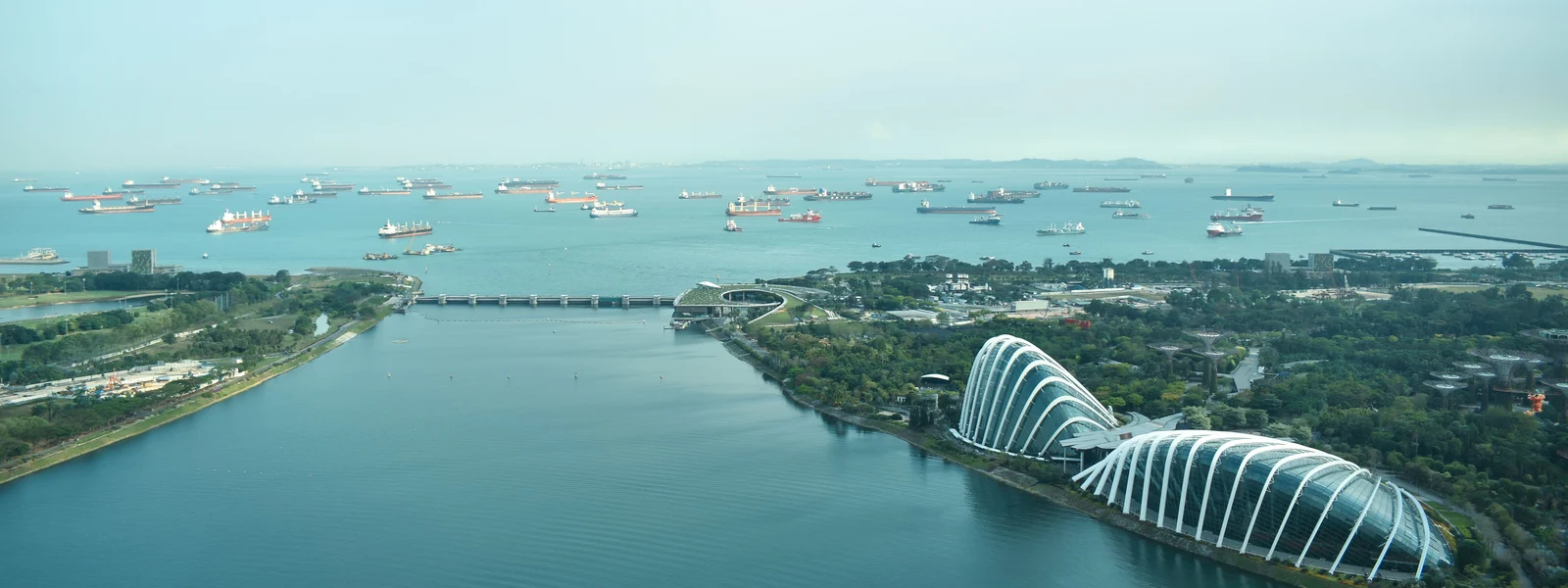
Singapore 5G & 4G coverage in 2026
Singapore is one of the best-connected places on Earth for mobile data. The city-state's three main operators, Singtel, StarHub, and M1, each cover 99% or more of the population with 4G, and all three have deployed 5G Standalone networks that collectively reach virtually every corner of the 734 km2 island. The differences between operators are measured in speed test rankings and 5G availability percentages, not in coverage gaps that would affect a tourist.
Singapore has no meaningful dead zones for visitors. The connectivity question here is not where signal exists but which operator delivers the fastest 5G and whether the eSIM you buy routes through the right one.
The three operators: performance at a glance
Singapore's mobile market is defined by exceptionally close competition between three full-network operators, all of which have deployed 5G Standalone infrastructure under spectrum allocations from the Infocomm Media Development Authority. Singtel, Singapore's largest operator with approximately 45% mobile market share and 4.6 million subscribers, holds the fastest median 5G download speed at 421.79 Mbps and the widest 5G coverage at 95% nationwide as of its July 2022 milestone, maintained through 2026. Singtel also achieved a landmark in September 2024: full 5G coverage across Singapore's entire MRT underground network, the only operator to have done so across all six underground lines including the Thomson-East Coast Line. StarHub achieved 99% outdoor 5G Standalone coverage in early 2024 with a median 5G speed of 369 Mbps across all technologies. M1 leads on 5G availability, meaning the percentage of time users with 5G-capable devices are actually connected to 5G, at 52.9% versus Singtel's 41.5% and StarHub's 48.1%.
For tourists and short-stay visitors, these performance differences are academic in most scenarios. Any of the three networks delivers the kind of connectivity that makes Singapore one of the most data-friendly cities in Asia. The differences appear on speed tests in controlled conditions and in the most demanding real-time use cases like 4K live streaming or latency-sensitive cloud gaming. For navigation, messaging, social media, video calls, and Grab bookings, all three operators provide performance that exceeds what most visitors experience on their home networks.
| Operator | 5G median speed | 5G SA coverage | Strength |
|---|---|---|---|
| Singtel | 421.79 Mbps | 95% + full MRT underground | Fastest 5G. Best consistency (96.2%). Only operator with 5G throughout MRT tunnels. |
| StarHub | 369 Mbps | 99%+ outdoor | Widest outdoor 5G coverage. Strong in CBD and residential areas. Excellent reliability. |
| M1 | 362 Mbps | Strong urban and suburban | Best 5G availability (52.9% time on 5G). Best 5G video experience score (79.0/100). |
Why Singapore has no tourist dead zones
Singapore's geography is its most useful mobile network characteristic. At 734 km2, it is smaller than many individual cities in neighbouring countries. Tower placement can achieve blanket coverage across the entire island with a relatively small number of strategically positioned sites. The result is that every location a tourist is likely to visit, from Changi Airport's terminals to Gardens by the Bay's supertree grove, from the hawker centres of Maxwell Road to the cable car between Sentosa and Mount Faber, has strong 4G and typically 5G from multiple operators simultaneously. There are no inter-island ferry crossings to worry about, no highland dead zones, and no wildlife corridors without towers. The closest Singapore gets to a coverage challenge is in the interiors of older, thick-walled buildings and in a handful of newly developed estates where initial infrastructure density was lower than established residential areas.
This makes Singapore fundamentally different from every other country in this guide series. The connectivity planning for a Singapore visit is not about knowing which areas have coverage and which do not. It is about knowing that the network is everywhere and choosing the plan that suits your duration and data volume rather than your itinerary.
The MRT network: 5G underground
Singapore's Mass Rapid Transit system is one of the world's most advanced urban rail networks, and since September 2024 it is also one of the most connected underground environments globally. Singtel achieved full 5G coverage across all six underground MRT lines, including the relatively new Thomson-East Coast Line, making it the first operator in Singapore to achieve this milestone. The deployment required installation work during non-operational hours to avoid disrupting train services, with engineers reconfiguring existing 3G and 4G hardware in MRT tunnels to support 5G rather than installing entirely new infrastructure.
The practical consequence for Singtel-connected travellers is that commuting on the MRT, including the underground portions of the North-South Line, East-West Line, Circle Line, Downtown Line, North East Line, and Thomson-East Coast Line, delivers 5G speeds throughout. StarHub and M1 users have 4G coverage throughout the MRT network, which was already standard before the Singtel 5G upgrade. For activities like navigating on the train using Google Maps, streaming music, messaging, or making video calls between stations, 4G is more than sufficient. The 5G upgrade matters for data-intensive tasks like 4K video streaming during commutes, which is the use case Singtel specifically highlighted in its launch announcement.
Key tourist areas: connectivity at each
Changi Airport, consistently rated the world's best airport, has multiple operators' 4G and 5G throughout all four terminals and the Jewel complex. eSIM activation on arrival is immediate and reliable in the terminals. The Changi Airport MRT station connects to the city, and signal is maintained throughout the underground connector. The journey from Changi to City Hall or Orchard on the East-West Line passes through several underground stations, all with 4G from all operators and 5G from Singtel.
Marina Bay and the city centre, including Marina Bay Sands, Gardens by the Bay, and the Merlion Park waterfront, have some of Singapore's densest tower deployment given the concentration of commercial activity, tourism infrastructure, and high-value real estate in the area. Orchard Road, Singapore's main retail corridor, has consistent 5G from all operators throughout its length. Sentosa Island, connected to the main island by cable car, Sentosa Express monorail, and road, has full 4G and 5G coverage including the beach areas, Universal Studios Singapore, and the resort zone. The cable car between Mount Faber and Sentosa crosses a short water section but maintains signal throughout because both shores are within coverage range and the crossing takes only a few minutes.
The hawker centres that define Singapore's food culture, from Newton Food Centre to Lau Pa Sat to Chinatown Complex, all have outdoor 4G and 5G. The heritage neighbourhoods of Chinatown, Little India, and Kampong Glam have strong coverage throughout. Haji Lane, Arab Street, and the shophouse corridors of these areas maintain signal even in the narrow-street sections where tower line-of-sight might be obstructed, because the density of surrounding towers compensates for any individual obstruction.
Speed expectations: what Singapore 5G actually delivers
Singapore's 5G speed figures are among the highest recorded in any country. Singtel's median 5G download at 421.79 Mbps is the fastest in Singapore and competitive with the world's leading 5G markets including South Korea and the UAE. StarHub's 369 Mbps and M1's 362 Mbps are not far behind. These are median speeds, meaning half of all 5G measurements on each network exceeded these figures. Peak speeds in optimal 5G conditions in Singapore's CBD reach 1 Gbps and above on all three operators. The all-technology median, combining 4G and 5G users, shows StarHub at 100.85 Mbps and Singtel competitive in the same range. Even Singapore's 4G speeds, operating on LTE-Advanced, routinely exceed the peak 5G speeds of less developed markets.
For tourists, these speed figures are largely irrelevant to daily experience because every common use case runs comfortably at speeds far below the network's capability. Google Maps navigation uses under 10 MB per hour. WhatsApp calls use 45 MB per hour. Grab bookings use 2 to 3 MB each. Even HD video streaming at 720p uses only 1.5 to 3 Mbps, a tiny fraction of what Singapore's 4G alone delivers. The network's speed abundance means that congestion, even at busy tourist sites during peak hours, is less likely to affect download performance than in markets where network capacity is tighter.
SIM registration in Singapore
Singapore requires passport or identification for SIM registration at point of sale, a standard requirement in place for some years. The process at Changi Airport counters is efficient and takes 10 to 15 minutes for tourist SIM purchases. Singtel, StarHub, and M1 all have counters in Changi's arrival halls. International eSIMs from non-Singapore providers are not subject to Singapore's local registration requirement, giving eSIM users the same zero-registration advantage as in Malaysia and Indonesia. Singtel also offers its own tourist eSIM product that can be purchased and installed before arrival, combining local operator routing with pre-travel convenience.
Singapore is the easiest country in this guide series for mobile connectivity. There are no dead zones, no offline ferry crossings, no highland dead zones, and no wildlife corridors without signal. Any of the three operators delivers excellent performance for tourist use. Singtel leads on 5G speed and MRT underground 5G coverage. StarHub leads on outdoor 5G coverage breadth. M1 leads on 5G availability. For most visitors, the eSIM choice is purely about price and plan size rather than network quality, because all three are excellent.
Plans for Singapore
Singapore eSIM plans
Prices in USD. Instant QR activation. Pick your data, land connected.
FAQ
Which Singapore operator is best for tourists?
Any of the three works excellently. Singtel leads on 5G speed (421 Mbps median) and is the only operator with 5G throughout the MRT underground network. StarHub has the widest outdoor 5G coverage. M1 has the best 5G availability percentage. For tourist activities, all three deliver more than enough performance for every standard use case.
Is there 5G on the Singapore MRT?
Yes. Singtel achieved full 5G coverage across all six underground MRT lines in September 2024, including the Thomson-East Coast Line. StarHub and M1 provide 4G throughout the MRT network. All operators maintain signal in MRT tunnels and stations, making Singapore's underground transit one of the world's best-connected rail environments.
Are there any dead zones in Singapore?
Essentially none for tourists. Singapore's compact 734 km2 geography allows blanket coverage across the entire island. The closest thing to dead zones are the interiors of older thick-walled buildings and a handful of newer estates with initial lower infrastructure density. No tourist destination or transport route has meaningful coverage gaps.
How fast is 5G in Singapore?
Singtel leads at 421.79 Mbps median 5G download. StarHub delivers 369 Mbps. M1 delivers 362 Mbps. These are median speeds, meaning half of all measurements exceed these figures. Peak speeds in Singapore's CBD reach 1 Gbps and above. Even Singapore's 4G speeds routinely exceed the peak 5G speeds of many other markets.
Does Singapore still have 3G?
Singtel began retiring 3G progressively from November 2024. The 3G sunset in Singapore is underway, with the network shifting to 4G and 5G exclusively as spectrum is reconfigured for 5G use. Tourists visiting in 2026 should expect 4G as the minimum, with 5G widely available across the island.